
Distribution Cones: The Wear Part That Quietly Sets Your VSI Output
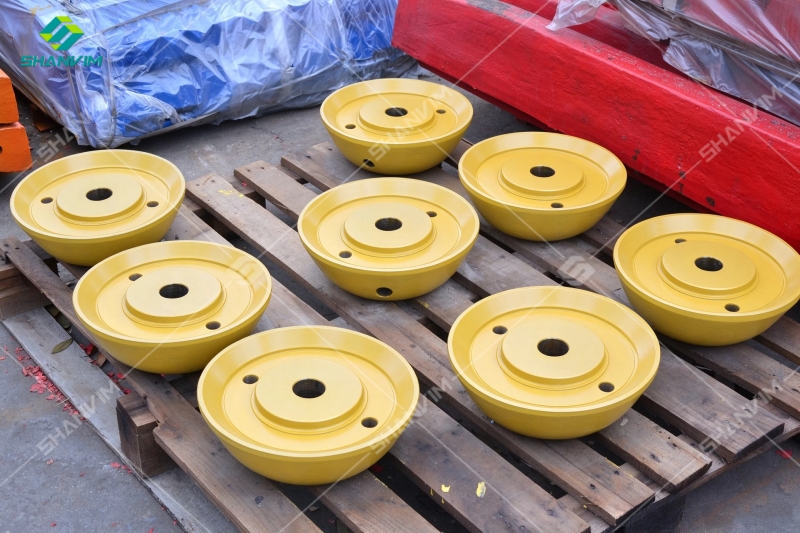
Every VSI sand line has one component that almost nobody photographs, almost nobody stocks as a spare, and almost everybody notices only after production has already dropped. It sits directly under the feed hopper, takes the first impact of every rock that enters the machine, and decides whether the rotor receives an even curtain of material or a concentrated stream that eats one side of the chamber. That component is the distribution cone.
A part that works in the dark
Walk through a sand-making plant during a shift and the loudest thing you hear is the rotor. The distribution cone is buried inside the feed assembly, usually behind a hopper, a feed tube and a wearing plate. It gives no signal, makes no noise of its own, and does not appear on most maintenance checklists. Yet the geometry of that cone sets the starting conditions for everything downstream: rotor load, throwing angle, chamber wear pattern, product shape and, ultimately, the cost per ton of finished sand.
In aggregate plants across Asia, Africa, Latin America and the Middle East, the same story repeats. A line that produced two hundred tons per hour last quarter is now delivering one hundred and sixty. The operator checks the motor, the belts, the screen decks and the feed size. Everything looks normal. Eventually somebody climbs into the feed chute and finds a distribution cone worn into a lopsided shape, its apex flattened, its skirt grooved on one side only. The machine was never broken. The feed was simply no longer being distributed.
What the cone actually does
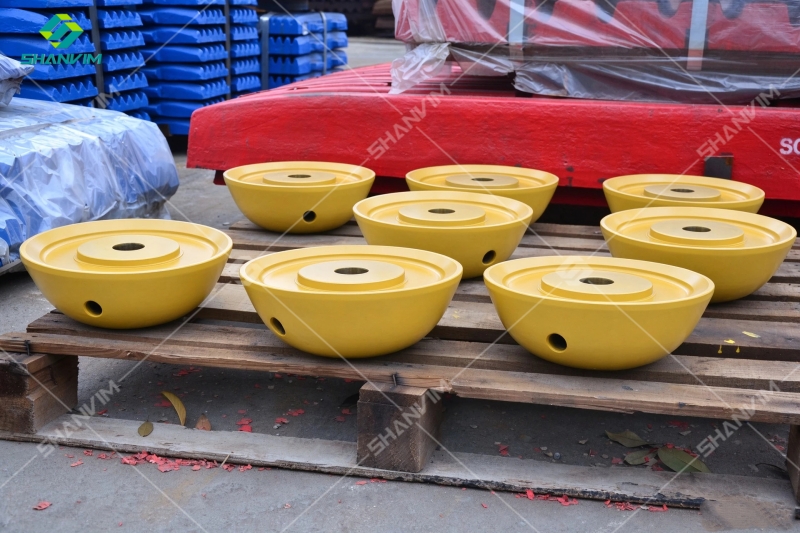
A distribution cone, sometimes called a feed cone, a distribution plate or a scattering cone, is a rotationally symmetric wear part mounted above the rotor of a vertical shaft impact crusher, or at the top of the crushing chamber in certain cone crushers. Material falls from the feed tube onto the cone’s apex. The cone’s angle converts that vertical fall into a radial spread, so that stone arrives at the rotor ports from all directions rather than from a single point.
Three functions follow from that geometry.
First, it equalises the feed. A rotor with three or four discharge ports needs an even supply at every port. If one port receives more stone, it throws more, wears faster, and changes the balance of the rotor. The cone is the cheapest device available for correcting that imbalance before it becomes mechanical damage.
Second, it protects the centre. The centre of the rotor, the top plate and the upper bearing area are not designed to absorb a direct, high-velocity stream of rock. The cone takes that impact on a sacrificial surface and spreads the energy sideways.
Third, it stabilises product shape. Even feed produces even acceleration, and even acceleration produces the inter-particle collisions that give VSI sand its characteristic cubical shape. A worn cone with a grooved face sends material into the rotor in pulses, which shows up as fluctuation in fineness modulus and an increase in flaky particles.
Material choices and what they cost
In practice, buyers meet four families of material for this part, and the choice rarely comes down to “the hardest one wins”.
Manganese steel, typically Mn13Cr2, is the traditional answer. It work-hardens under impact, tolerates shock loading, and is forgiving in service. It is inexpensive to cast and easy to source. Its weakness is abrasion: in a sand circuit dominated by quartz, a manganese cone can lose its profile quickly, and once the profile is gone the part is no longer doing its job even though it has plenty of metal left.
High chrome cast iron, commonly CR26 or CR27, is the volume choice for VSI sand making. Hardness in the range of fifty-eight to sixty-three HRC gives it far better resistance to sliding abrasion than manganese, and it holds its shape longer, which matters more than total wear life because shape is function. The trade-off is brittleness. High chrome does not enjoy hammer blows, thermal shock or being dropped from a truck onto concrete.
Hardfacing and composite builds place a carbide-rich layer on a tougher substrate. These are the answer for operations where a single material cannot cover both impact and abrasion, and they are increasingly common in premium aftermarket supply.
The commercial lesson is simple. A buyer who asks only for the cheapest cone per kilogram will usually pay more per ton of sand produced. A buyer who asks which material matches the feed’s silica content, the rotor speed and the feed size distribution gets a part that lasts and a machine that stays predictable.
Reading the wear pattern
A used distribution cone is a diagnostic record. Its surface tells the maintenance team what the machine has been doing, and reading it is more useful than reading an hour meter.
A flattened apex indicates sustained direct impact at the centre, often from a feed tube that is too close or a feed that arrives in a single dense stream. The stone never had a chance to spread.
One-sided grooving points to a feed chute that is off-centre, a misaligned feed tube, or a rotor running with an imbalance. In many cases the cone is blamed for a problem created upstream.
Uniform shallow polishing with no deep channels is the signature of a well-set machine and a correctly matched material. This is what a healthy installation looks like after a full campaign.
Cracking or spalling on a high chrome cone usually means the part was mishandled during installation, hit by tramp metal, or subjected to a sudden temperature change. It is rarely a material defect and almost always an operating condition.
Selection guidance for buyers
A practical specification conversation covers six points, and none of them requires a laboratory.
1.Feed size and silica content. Hard, quartz-rich feed pushes the choice toward high chrome or ceramic. Limestone and softer aggregate tolerate manganese comfortably.
2.Rotor speed and installed power. Higher speed means higher exit velocity and more aggressive wear at the cone skirt. The part must be specified for the duty, not for the machine model alone.
3.Feed moisture and stickiness. Wet, clay-bearing feed can build up on the cone face and destroy the distribution pattern long before wear becomes the issue. In those plants, geometry and surface finish matter as much as hardness.
4.Installation method. Bolted, keyed, or clamped mounting determines how quickly a spare can be changed and whether the change is done correctly under production pressure.
5.Dimensional tolerances. A cone that is two millimetres off at the mounting face can produce visible imbalance at operating speed. Tolerances belong in the purchase order, not in a verbal agreement.
6.Spare strategy. Because this part fails quietly, holding one spare on site is cheaper than waiting for a shipment. Plants running continuous campaigns should keep a second cone on the shelf.
Three mistakes that shorten service life
The first is installing a new cone onto a worn rotor. The cone will inherit the old imbalance and wear unevenly within weeks. The rotor and the cone should be assessed together.
The second is mixing material families on the same machine. A manganese cone in one campaign and a high chrome cone in the next will behave differently under the same settings, and operators who do not adjust the feed will draw the wrong conclusion about quality.
The third is treating the cone as a consumable that needs no inspection. A five-minute check at every rotor change, looking for apex flattening and one-sided grooving, prevents the far more expensive discovery that the chamber liner has been wearing on one side for a month.
A supply chain note
For buyers sourcing from Chinese foundries, the practical questions are consistent: whether the foundry controls pouring temperature and heat treatment, whether it can document hardness and chemistry per batch, and whether it can hold dimensional tolerance across repeat orders. A distribution cone is a small line item on an invoice and a large line item in the cost of a stopped plant. That asymmetry is why the specification deserves a proper conversation rather than a price comparison.
The takeaway
The distribution cone does not decide how hard the crusher hits. It decides where the hitting happens. Every ton of sand that leaves a VSI plant has passed over that surface first, and the shape it leaves with has a good deal to do with the shape of the cone underneath.
Plants that treat this part as a strategic spare, matched to feed and rotor duty, report fewer unplanned stops and more stable gradation. Plants that treat it as a cheap casting to be replaced when something finally breaks spend their maintenance budget somewhere else in the machine, usually in a much larger component.
For operators, the message is unglamorous and useful: check the top of the machine before blaming the bottom. The smallest wear part in the feed assembly is often the first place where a production problem becomes visible, and the cheapest place where it can be fixed.
SHANVIM as a global supplier of crusher wearing parts, we manufacture cone crusher wearing parts for different brands of crushers. We have more than 20 years of history in the field of CRUSHER WEAR PARTS. Since 2010, we have exported to America, Europe, Africa and other countries in the world.
Post time: Nov-05-2026