
Scientific Material Selection of Grinding Roller for Raymond Mill and Vertical Roller Mill
In the modern mineral processing, powder grinding and industrial raw material milling industry, Grinding Roller stands as one of the most indispensable and high-consumption wearable components for milling equipment. As the core executive part responsible for material squeezing, rolling and fine grinding, it directly contacts and crushes various ores and industrial raw materials during equipment operation. Its material quality, mechanical performance and wear resistance fundamentally determine the overall operating stability, finished powder uniformity, daily output capacity, equipment failure rate and long-term operation and maintenance cost of the entire production line. In actual industrial on-site operation, most common problems including rapid component wear, shortened service life, frequent equipment shutdown and repeated accessory replacement are mainly caused by unscientific grinding roller material selection mismatched with working conditions. For powder processing enterprises pursuing high efficiency, low consumption and stable production, mastering professional and standardized grinding roller material matching standards is a core prerequisite to reduce production costs and improve comprehensive economic benefits.
Basic Definition and Application of Grinding Roller
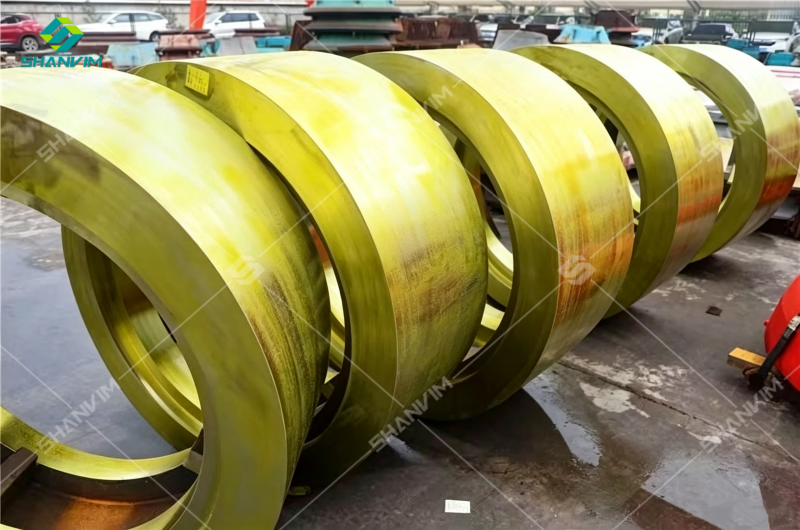
Grinding Roller is a professional customized wearable roller assembly and outer roller shell component specially used for material high-pressure extrusion and ultra-fine grinding in industrial milling machinery. In the current powder processing field, this core accessory is mainly and widely applied to two mainstream industrial grinding equipment: Raymond Mill and Vertical Roller Mill. Although the internal structure and operating principle of the two types of milling equipment are slightly different, the core grinding logic is consistent. Both rely on the high-speed rotation and high-pressure extrusion of grinding rollers, matching with fixed grinding rings to squeeze, grind and crush granular raw ores into standard fine powder materials that meet industrial production standards.
As a classic medium and small-sized powder making device, Raymond Mill is widely used in fine grinding and processing of various non-metallic minerals such as limestone, barite, talc, gypsum and coal powder, featuring flexible operation, low energy consumption and stable fine powder output, and is suitable for small and medium-scale processing scenarios. Vertical Roller Mill is a large-scale heavy-duty industrial grinding equipment, specially used for high-volume processing of cement raw materials, mineral slag, fly ash and various high-hardness industrial raw materials, with super large output and extremely high mechanical wear intensity in operation. In both types of equipment, the Grinding Roller bears the strongest long-term mechanical friction, extrusion and impact load in the whole machine, so its material performance is the decisive core factor that restricts the equipment continuous operation cycle and accessory replacement cycle.
Mainstream Production Materials of Grinding Roller
At present, professional and mature wearable parts manufacturers in the industry mainly focus on two mature and reliable material systems for mass production of industrial grinding rollers: high manganese steel series and high chromium white cast iron series. Among them, Mn13Cr2, Mn18Cr2 and Cr26 are the most mainstream and widely used mature grades, which have passed long-term market verification and industrial field tests. Each material has completely different mechanical properties, wear resistance, toughness and stress resistance, and corresponds to exclusive targeted working conditions. It is impossible and unscientific to adopt a single material for all grinding scenarios in actual production selection.
Mn13Cr2 and Mn18Cr2 high manganese steel are the most conventional, stable and cost-effective mature mass-production materials in the market. The biggest core advantage of high manganese steel lies in excellent comprehensive impact toughness and super strong crack resistance, which is incomparable to other ordinary wear-resistant steels. Different from conventional steel materials, high manganese steel has a unique physical property of work hardening. When the grinding roller runs for a long time and is subjected to continuous ore impact and strong extrusion pressure, the surface metal structure will be continuously compacted and hardened, realizing the unique performance characteristic of the more it is used, the harder it gets. This excellent performance can effectively resist sudden strong impact caused by irregular large-particle materials accidentally entering the equipment, thoroughly avoid common failures such as roller shell cracking, surface peeling and bulk material falling off, and fully guarantee the long-term continuous and stable operation of the powder production line.
In the high manganese steel series, Mn13Cr2 is a classic upgraded optimized material. On the basis of traditional ordinary manganese steel, an appropriate proportion of chromium elements is added, which effectively optimizes the overall wear resistance and oxidation resistance of the material while retaining super high toughness and impact resistance. It is suitable for most medium and low wear working conditions and complex scenarios of mixed processing of soft and medium-hard ores, with high cost performance and wide applicability. Mn18Cr2 is a high-grade upgraded manganese steel alloy material, with higher manganese-chromium alloy ratio, more compact internal metal structure, stronger structural stability and better fatigue resistance. Its overall service life is significantly improved compared with Mn13Cr2, making it very suitable for complex production lines with uneven feeding particle size, many large lump materials and frequent strong impact loads.
Cr26 high chromium white cast iron is a high-end professional wear-resistant material specially developed for high-wear and high-load grinding working conditions. After strict professional integral heat treatment and quenching process, a large number of densely distributed high-hardness chromium carbide crystal structures are formed inside the material, and the overall surface hardness can stably reach HRC 58-65. Its professional wear resistance is far higher than that of traditional high manganese steel materials. In the grinding and processing of high-hardness and high-abrasive minerals such as quartz stone, feldspar, high-silicon limestone and granite, the effective service life of Cr26 high chromium cast iron grinding roller is 2 to 3 times that of ordinary manganese steel products. It is the optimal preferred material for long-term uninterrupted high-load and high-wear industrial grinding working conditions.
At the same time, it is worth noting the performance limitations of Cr26 high chromium cast iron. Compared with high manganese steel materials, its toughness and impact resistance are relatively weaker, and it is prone to local cracking and damage under sudden violent impact of super-large hard materials. Therefore, this material is more suitable for standardized production lines with uniform feeding particle size, stable material properties and no large hard impurities. In stable and standardized continuous grinding environments, Cr26 grinding rollers can give full play to their ultra-long wear-resistant advantages and maximize production efficiency and service life.
Scientific Selection Rules for Grinding Roller Materials
In actual industrial production, to obtain the best equipment operation effect and minimize the comprehensive production and maintenance cost, processing enterprises must follow three core dimensions to select grinding roller materials scientifically and accurately, including raw ore material hardness, on-site feeding impact condition and matching equipment type, and avoid blind material selection.
For soft and medium-low hardness materials with low wear characteristics, such as coal powder, gypsum, talc and dolomite, Mn13Cr2 and Mn18Cr2 high manganese steel are the most cost-effective and reliable choices. Their excellent toughness can effectively resist frequent material impact and avoid frequent component damage and shutdown replacement. For high-hardness, high-silicon and strong abrasive minerals that cause serious wear to accessories, Cr26 high chromium white cast iron must be prioritized to greatly reduce replacement frequency and reduce long-term operating costs.
In terms of equipment matching, Raymond Mill with medium and small output and complex and changeable feeding conditions has higher requirements for component toughness, so high manganese steel products have stronger on-site adaptability. For large-scale Vertical Roller Mill used in cement, slag and coal powder processing, which features stable feeding, large processing capacity and high long-term wear load, Cr26 high chromium wear-resistant materials can significantly improve overall milling efficiency and effectively reduce later equipment maintenance and accessory replacement costs.
Summary
In conclusion, scientific matching of Grinding Roller material is the core key to realize efficient, stable and low-consumption operation of Raymond Mill and Vertical Roller Mill. The high manganese steel series represented by Mn13Cr2 and Mn18Cr2 focuses on super impact resistance and operational stability, adapting to complex and changeable grinding working conditions. The Cr26 high chromium white cast iron focuses on ultra-high wear resistance, perfectly matching high-hardness and high-wear processing scenarios. Reasonable and targeted material selection according to actual on-site working conditions can effectively reduce equipment failure rate, greatly extend the service life of core wearable accessories, stabilize continuous production, and finally create more considerable economic benefits for powder processing enterprises.
SHANVIM as a global supplier of crusher wearing parts, we manufacture cone crusher wearing parts for different brands of crushers. We have more than 20 years of history in the field of CRUSHER WEAR PARTS. Since 2010, we have exported to America, Europe, Africa and other countries in the world.
Post time: Jul-02-2026