
In the demanding world of aggregate production, few materials present as significant a challenge to processing equipment as river cobblestone. This naturally occurring silica-based rock is not only abundant but notoriously abrasive, placing immense stress on the primary crushing stage. For operations utilizing jaw crushers, the selection of the jaw plate—the wear component that directly contacts the feed—has become a critical decision that separates profitable, continuous operation from a cycle of costly downtime and maintenance chaos.
Industry data and field reports increasingly point to a common point of failure: the continued use of conventional carbon steel or low-alloy steel liners in cobblestone applications. SHANVIM, a recognized manufacturer of crushing wear parts, has observed that many operators underestimate the specific wear mechanisms at play when crushing hard, abrasive rocks. The result is often a rapid decline in crusher performance and a significant increase in operational expenditure.
The Mechanical Inadequacy of Traditional Steels
Traditional jaw plate materials, such as ordinary carbon steel or low-alloy steel, are characterized by their relatively low hardness and insufficient resistance to abrasion. When these materials are tasked with crushing cobblestone—which can register a compressive strength exceeding 300 MPa—they fail on two fronts. Firstly, the low hardness allows the abrasive rock to micro-cut and gouge the jaw plate surface, leading to rapid loss of tooth profile. Secondly, the insufficient yield strength of these lower-grade materials makes them susceptible to plastic deformation under the high compressive loads generated during crushing. This deformation results in the jaw plate “flowing” or “mushrooming,” causing the crusher’s closed side setting (CSS) to change unpredictably.
For operators, the consequences are immediate and detrimental. As the jaw plate wears unevenly, the crushing chamber geometry is compromised. The crusher begins to produce a coarser product, requiring recirculation in closed-circuit operations. More pressing is the reduction in throughput capacity; a worn jaw plate cannot effectively grip and crush the material, leading to slippage and a measurable drop in tons per hour (TPH). Frequent replacements, necessitated by both wear and deformation, become the norm. This escalates not just the direct cost of the jaw plate itself but also the indirect costs associated with labor, crane hire, and the significant penalty of production downtime—losses that can far exceed the price of the component.
The Metallurgical Advantage of High-Manganese Steel
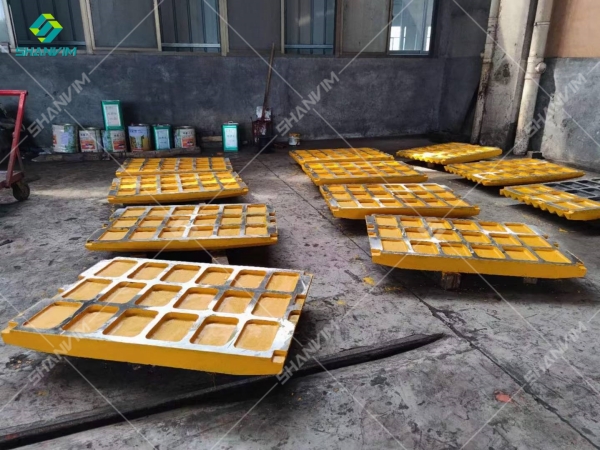
In direct contrast to the performance of standard steels, SHANVIM advocates for the use of high-manganese steel (often specified as Mn13% or Mn18%) as the optimal solution for cobblestone crushing. The distinction lies not merely in its initial chemistry, but in its unique dynamic response to mechanical stress.
High-manganese steel exhibits a property known as work-hardening, or strain hardening. Under the impact and compression of crushing hard rocks like cobblestone, the surface layer of the jaw plate undergoes a transformation. The intense pressure causes the austenitic structure of the steel to convert into a harder, more wear-resistant martensitic layer. This surface hardness can increase significantly, from an initial Brinell hardness of approximately 200-250 HB to levels exceeding 500 HB under heavy service conditions. This phenomenon means that the jaw plate effectively becomes harder as it is used, creating a self-protecting wear surface.
For the end-user, this translates to a paradigm shift in wear life. While the initial purchase cost of a high-manganese jaw plate is higher than that of a conventional carbon steel liner, the extended service life—which can be three to five times longer in severe cobblestone applications—delivers a substantially lower total cost of ownership. The frequency of change-outs is dramatically reduced, minimizing downtime for maintenance and allowing the crusher to operate at a consistent, predictable output level.
SHANVIM’s Commitment to Application-Specific Engineering
Recognizing that not all crushing applications are identical, SHANVIM emphasizes that material selection must be tailored to the specific feed characteristics. While high-manganese steel is the preferred choice for high-impact, high-abrasion scenarios involving cobblestone and other hard rocks, SHANVIM also cautions against its use in applications where impact energy is low, as the work-hardening effect will not be fully activated.
The company’s engineering approach focuses on matching the jaw plate chemistry and design to the specific operational conditions. For cobblestone projects, SHANVIM’s recommended high-manganese grades have been optimized to ensure rapid work-hardening while maintaining the necessary toughness to resist breakage. This balance is crucial; a jaw plate that is too brittle may fracture under impact, while one that is too soft will deform plastically. SHANVIM’s metallurgical expertise ensures that the jaw plates achieve the optimal combination of hardness, toughness, and work-hardening capacity.
Economic Implications and Strategic Sourcing
The decision regarding jaw plate material is fundamentally an economic calculation. The lower price of a carbon steel liner is often misleading when assessed over the lifetime of a crusher. The cost of a single jaw plate replacement includes not only the part cost but also the logistics of delivery, the crane and rigging required for the change-out, the labor hours of maintenance personnel, and the lost production revenue during the downtime.
In a 24/7 operation, a switch to high-manganese steel from SHANVIM can reduce the number of annual change-outs from, for example, four to just one. This reduction has a compound effect on plant availability. Furthermore, consistent jaw plate profile retention ensures that the crusher maintains its designed capacity and product size consistency, eliminating the gradual performance degradation characteristic of softer materials.
SHANVIM’s offerings are backed by rigorous quality control in steelmaking and heat treatment, ensuring that the metallurgical structure is optimized to achieve the desired performance. The company’s ability to cast and machine jaw plates to precise dimensions ensures a proper fit within the crusher frame, preventing premature failure due to loose components or improper clamping.
Operational Best Practices
Beyond material selection, SHANVIM emphasizes the importance of operational practices that maximize jaw plate life. This includes proper feeding distribution, ensuring an even wear profile across the jaw plates. Practices such as feeding from one side of the crusher can lead to unbalanced wear, potentially requiring earlier replacement despite the superior material properties.
Additionally, regular monitoring of the jaw plate profile helps operators predict change-out schedules, allowing for planned maintenance rather than unplanned shutdowns. While high-manganese steel offers a robust solution, it is not indestructible, and best practices ensure that its full wear potential is realized.
Conclusion: A Strategic Upgrade for Enhanced Productivity
For any operation processing cobblestone, the argument for upgrading to high-manganese jaw plates is compelling. The enhanced wear resistance, coupled with the work-hardening capability, directly addresses the primary failure mechanisms that plague standard carbon steel liners. By reducing downtime, maintaining consistent throughput, and lowering the frequency of replacement, SHANVIM’s high-manganese jaw plates enable producers to achieve a more predictable and profitable production schedule.
SHANVIM’s position in the wear parts industry is strengthened by its focus on providing value through engineering and metallurgical excellence. As the demand for high-quality aggregates continues to rise, the choice of wear components becomes increasingly strategic. For crusher operators facing the harsh realities of cobblestone processing, SHANVIM’s high-manganese solutions represent not just an upgrade, but a fundamental component of operational success.
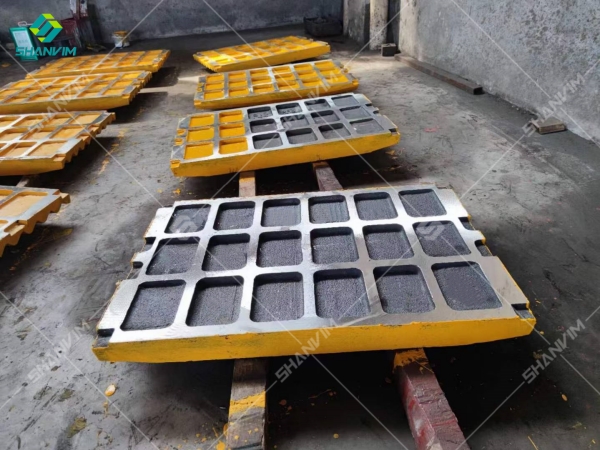
SHANVIM as a global supplier of crusher wearing parts, we manufacture cone crusher wearing parts for different brands of crushers. We have more than 20 years of history in the field of CRUSHER WEAR PARTS. Since 2010, we have exported to America, Europe, Africa and other countries in the world.
Post time: Jun-17-2026