
SHANVIM Unveils Advanced Technical Insights into Swing Jaw Plate Design and Material Science for High-Performance Crushing Operations.
In mineral processing, aggregate production and construction waste recycling, the jaw crusher’s swing jaw plate acts as the core wear component connecting equipment and materials. Bearing continuous impact, compression and abrasion, it directly determines crushing throughput, energy efficiency and overall operating costs. Amid the global pursuit of high productivity and low-carbon operation, optimized wear parts have become essential for industrial crushing systems. As a professional foundry and customized engineering enterprise, SHANVIM has built a full-dimensional technical system for swing jaw plates, covering material selection, structural optimization, surface protection and customized manufacturing to comprehensively boost crushing stability and economy.
The Golden Rule of Material Selection: Balancing Hardness with Toughness
The lifeblood of any swing jaw plate is its material composition. For decades, the industry has struggled with a fundamental trade-off: harder materials resist abrasive wear but crack under impact, while tougher materials absorb shock but deform rapidly under continuous compression. SHANVIM’s latest technical guidance redefines this equilibrium by advocating a graded material selection strategy based on feed stock characteristics.
High-manganese steel remains the cornerstone of heavy-duty crushing. Grades such as Mn13Cr2, Mn18Cr2, and Mn22Cr2 are carefully deployed depending on the compressive strength and abrasiveness of the target material. The Mn13Cr2 alloy delivers exceptional work-hardening capabilities—its surface hardness can double from 220 HB to over 500 HB under impact, making it ideal for medium-hard limestone and recycled concrete. For harder igneous rocks like granite or basalt, Mn18Cr2 offers enhanced initial hardness and superior resistance to gouging abrasion. Where extreme impact and high silica content coexist, Mn22Cr2, with its elevated chromium and carbon content, provides the ultimate defense against premature failure. This tiered approach ensures that plant operators are not overpaying for excessive alloying elements on soft feeds, nor risking catastrophic breakage on hard ores with under-spec materials.
Beyond the standard high-manganese family, SHANVIM’s research highlights the rising importance of alloy steels for intermediate applications. These materials, often heat-treated to specific hardness ranges (350–450 HB), offer a stable wear profile without relying heavily on impact-induced hardening—a critical advantage in low-impact scenarios such as secondary or tertiary crushing. Meanwhile, composite materials are emerging as the frontier of innovation. By metallurgically bonding a wear-resistant overlay to a tough, low-alloy steel backing, SHANVIM engineers have achieved a synergistic effect: the outer layer resists scratching and micro-cutting, while the inner core absorbs cyclic loading and prevents through-thickness cracking. This hybrid architecture is particularly valuable in recycling operations where tramp iron and rebar are common contaminants.
Structural Wisdom: The Geometry of Efficiency and Energy Savings
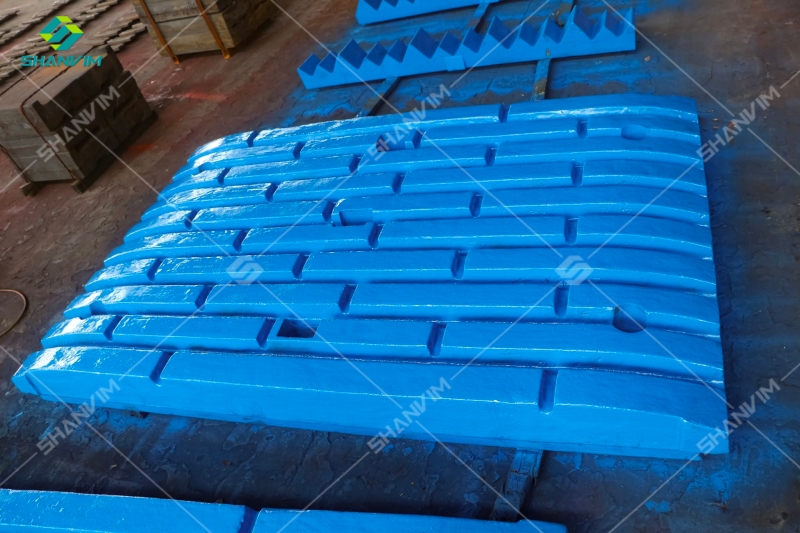
Material alone cannot deliver optimal performance; the geometry of the swing jaw plate must be scientifically designed to translate crushing force into particle reduction with minimal energy loss. SHANVIM’s engineering team has invested extensively in finite element analysis (FEA) and discrete element modeling (DEM) to refine the tooth profile, weight distribution, and mounting interface of their swing jaw plates.
Tooth geometry is a decisive factor in bite efficiency. Traditional straight-tooth designs often allow feed material to slide downward during the compression stroke, wasting energy and accelerating localized wear. SHANVIM’s optimized curved and staggered tooth configurations create a positive gripping action that reduces material slippage by up to 18%, according to internal testing. The tooth pitch and height are calibrated to the expected feed size distribution—coarser feeds demand deeper, wider valleys to trap individual rocks, while finer feeds benefit from a denser tooth array that increases the surface area for comminution. This tailored approach ensures that the crushing chamber consistently operates in its most efficient zone, minimizing recirculating loads and reducing the power draw per ton of finished product.
Weight balance is another subtle yet crucial consideration. Excessively heavy jaw plates increase the inertia that the toggle mechanism must overcome, raising energy consumption and stressing the pitman and eccentric shaft. Conversely, underweight plates lack the necessary momentum to crack hard rocks, resulting in intermittent crushing and elevated peak loads. SHANVIM employs a ribbed back design that strategically places mass where structural support is needed most, achieving an optimal strength-to-weight ratio. This careful mass distribution not only reduces the kinetic energy penalty but also dampens vibrations, extending the life of both the jaw plate and the crusher frame.
Equally transformative is the mounting interface. SHANVIM has pioneered a wedge-lock fastening system that eliminates the need for extensive welding or cumbersome bolt arrangements during replacement. The new design utilizes precision-machined keyways and hydraulic wedge tightening, enabling a single operator to complete a jaw plate change-out in under two hours—a dramatic reduction from the typical four- to six-hour downtime. This quick-change capability translates directly to higher annual production capacity, particularly for operations that process highly abrasive materials and require monthly or bi-monthly wear-part replacements.
Surface Engineering Secrets: The Unseen Protectors Against Wear
While bulk material properties and geometry provide the foundation, surface treatment is where the service life of a swing jaw plate is truly extended. SHANVIM has systematized three complementary technologies to combat the four primary wear mechanisms—abrasion, adhesion, fatigue, and corrosion.
The first line of defense is hardfacing or weld overlay. Localized wear patterns, particularly at the inlet and outlet zones of the crushing chamber, can be restored in situ using specialized flux-cored wires. SHANVIM offers pre-mapped overlay patterns that deposit a chromium-carbide-rich microstructure on high-wear regions without affecting the ductile core of the plate. This selective reinforcement extends the usable life by 30–50% before the plate needs to be stripped and recast. Importantly, the company provides detailed reconditioning protocols, including preheat temperatures, interpass cooling, and post-weld stress-relief cycles, to prevent hydrogen-induced cracking or dilution of the base material.
The second technique is surface hardening through thermal or thermochemical diffusion processes. Unlike bulk hardening, which may reduce overall toughness, surface hardening creates a case depth of 2–5 mm with hardness values exceeding 600 HV. The core of the plate retains its original toughness, ensuring resistance to impact spalling. SHANVIM has perfected a low-temperature carburizing process for their Mn18Cr2 and Mn22Cr2 alloys that preserves the austenitic structure while generating a gradient of hardness from the surface inward. This gradient prevents the abrupt transition that often causes delamination under heavy loads.
The third and most advanced approach involves the application of nano-engineered coatings. These novel thin-film barriers, composed of titanium-based or aluminum-oxide ceramic nanoparticles suspended in a polymer matrix, are applied via electrostatic spray and baked to form a density-controlled layer. The coating does not merely add hardness; it fundamentally alters the sliding friction between the jaw plate and the rock. Field trials have shown a 12–15% reduction in the coefficient of friction, which translates to less heat generation, lower energy consumption per crushing stroke, and a reduction in adhesive wear that occurs when fine particles weld to the plate surface under high pressure. While still emerging, this nanotechnology holds the promise of extending plate life in wet or sticky applications, where conventional materials suffer accelerated loss due to chemical corrosion and clogging.
SHANVIM’s Integrated Customization Ecosystem: From Blueprint to Production
Recognizing that no two crushing operations are identical, SHANVIM has built a flexible manufacturing ecosystem that accommodates bespoke requirements. The company produces all standard and non-standard castings, supporting a wide range of jaw crusher models, from compact units processing 50 tons per hour to primary giants handling over 1,500 tons per hour. Their foundry is equipped with advanced molding lines, automated heat-treatment furnaces, and precision machining centers that guarantee dimensional accuracy within ±0.5 mm on critical mounting surfaces.
For clients with existing equipment, SHANVIM offers a comprehensive reverse-engineering service. Using 3D laser scanning, the technical team can generate accurate CAD models of worn or broken jaw plates within hours, even in remote field locations. From these digital twins, they perform stress simulation to identify weak points in the original design, then propose a revised geometry or upgraded alloy to mitigate failure risks. This design-for-reliability approach has been instrumental in helping mines transition from obsolescent designs to modern, high-efficiency profiles without scrapping their entire crusher chassis.
Furthermore, SHANVIM’s material-science laboratory provides metallurgical analysis of failed plates from client sites. By examining fracture surfaces, hardness gradients, and chemical composition of worn samples, the team can pinpoint whether the failure was due to impact overload, abrasion beyond design limits, improper heat treatment, or tramp-metal damage. This forensic capability enables data-driven recommendations for future plate specifications, allowing customers to fine-tune their wear-part strategy as ore bodies change or production targets intensify.
The Economic and Operational Impact
The cumulative effect of SHANVIM’s material, structural, and surface innovations is a palpable boost to operational profitability. Consider a typical medium-scale aggregate plant processing 500 tons per hour of abrasive river gravel. With conventional jaw plates, a change-out may be required every 600 hours, costing not only the component price but also eight hours of crane time, labor, and lost production—equivalent to roughly 4,000 tons of output. By upgrading to SHANVIM’s Mn22Cr2 plates with optimized tooth geometry and selective hardfacing, the change-out interval can be extended to 1,000 hours while reducing the installation time to two hours. Over a 6,000-hour operating year, this translates to two fewer change-outs, recovering nearly 8,000 tons of production and saving hundreds of man-hours.
Energy savings are equally compelling. The reduced friction coefficient and improved bite geometry lower the crusher’s specific energy consumption by 5–8%, a meaningful margin for operations running on diesel generators or high-tariff electricity grids. Over the course of a year, these kilowatt-hour reductions can offset a significant portion of the plate’s initial purchase cost, making the premium-grade materials a net-positive investment.
Future Outlook: Smart Wear Monitoring and Predictive Maintenance
Looking ahead, SHANVIM is integrating IoT-enabled wear sensors into their swing jaw plates, allowing real-time monitoring of thickness reduction and temperature spikes. This data, fed into predictive maintenance algorithms, will alert plant managers to impending wear-out conditions days in advance, enabling scheduled downtime rather than emergency stoppages. Combined with the company’s existing reverse-engineering and rapid-casting capabilities, this digital integration will create a closed-loop lifecycle management system—from first installation to final recycling of the worn plate, every stage will be optimized for maximum value.
Conclusion
The swing jaw plate is far more than a passive wear liner; it is a dynamic engineering system that governs the heart of a crushing plant. SHANVIM’s deep expertise in high-manganese alloys, geometric optimization, surface enhancement, and customizable fabrication provides a holistic solution that addresses the challenges of modern mineral processing. By selecting the right material for the specific feed, embracing intelligent tooth designs, and leveraging advanced surface technologies, operators can achieve unprecedented levels of efficiency, reliability, and cost control. As SHANVIM continues to push the boundaries of foundry science and digital engineering, the industry can look forward to crushing equipment that not only breaks rocks but also breaks the cycle of high maintenance costs and unpredictable downtime—setting a new standard for performance in the heavy industrial sector.
For more information about SHANVIM’s custom swing jaw plate offerings or to request a technical consultation and reverse-engineering service, please contact the company’s engineering support team directly. With a commitment to quality, innovation, and partnership, SHANVIM stands ready to equip the world’s toughest crushing applications with the next generation of wear solutions.
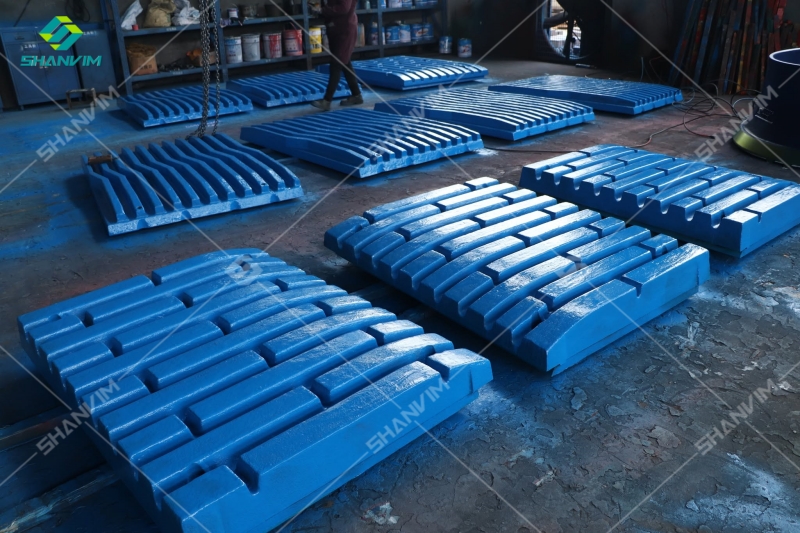
SHANVIM as a global supplier of crusher wearing parts, we manufacture cone crusher wearing parts for different brands of crushers. We have more than 20 years of history in the field of CRUSHER WEAR PARTS. Since 2010, we have exported to America, Europe, Africa and other countries in the world.
Post time: Aug-27-2026