
CRUSHING THE MYTH: WHY YOUR BLOW BAR SNAPS SOON AFTER INSTALLATION
Every aggregate producer knows the sinking feeling. A brand-new set of blow bars goes into the primary impact crusher, the rotor spins up to speed, and within a matter of shifts—sometimes even hours—a loud clanging noise signals catastrophe. The blow bar has fractured clean across its section, or worse, split into multiple pieces that now threaten the entire rotor assembly.
This news feature walks you through the real reasons behind premature blow bar fracture, and more importantly, what SHANVIM does to help you prevent it.
1. FEED MATERIAL: THE SILENT KILLER OF BLOW BARS
The first question our technical team always asks is: “What are you putting into the crusher?” The answer often explains everything.
Blow bars are designed to crush rock by impact energy. But impact energy has a narrow optimal window. When the feed contains excessive tramp iron (rebar, bolts, digging teeth) or oversized boulders that exceed the crusher’s nominal feed opening by more than 20%, the blow bar experiences a sudden overload condition. Unlike slow compression wear, impact overload creates a shockwave that travels through the bar’s crystalline structure. If the bar is made of high-chromium white iron (which has excellent abrasion resistance but lower toughness), that single tramp iron event can initiate a micro-crack at the blow bar’s mounting hole or back face. Within minutes of continuous high-speed rotation, that micro-crack propagates into a full catastrophic fracture.
At SHANVIM, we now offer a free feed-size audit for every new customer. Our portable laser profiler measures your actual feed gradation against the crusher’s design envelope. If we detect oversize material exceeding 15% of the total throughput, we will not simply ship standard blow bars – we recommend either a tougher martensitic steel grade (with 25% higher impact toughness than conventional Mn18Cr2) or a redesigned bar geometry with reinforced back ribs. We have reduced fracture-related claims by 62% among customers who adopted this pre-screening advisory.
2. INSTALLATION TORQUE AND RETAINING SYSTEM: THE OVERLOOKED VARIABLE
You would be amazed how many blow bars break because they were never properly tightened.
The blow bar is held in the rotor by wedge locks or clamping bolts, each requiring a specific torque sequence. When the tightening torque is uneven—for example, one bolt at 450 Nm while the adjacent bolt reaches only 320 Nm—the bar experiences bending stress every time it passes through the crushing chamber. Under centrifugal force (which can exceed 50 G at 600 rpm), this unbalanced clamping acts like a repeated three-point bending test. After 50,000 to 80,000 cycles, the bar’s lower section, near the clamp slot, develops a fatigue crack that runs parallel to the bar’s length. Eventually, the crack turns upward and separates the bar into two longitudinal halves—a failure mode many operators mistakenly blame on “poor material ductility.”
SHANVIM’s solution is twofold. First, we laser-etch torque specifications and tightening sequences directly onto the side face of every blow bar set. Second, we supply a digital torque wrench adapter that records peak torque values for each bolt and stores them via Bluetooth. Our service engineers can remotely review your installation logs. If we see a torque deviation exceeding ±8%, we alert you before the rotor even starts. This proactive monitoring has virtually eliminated clamping-related failures for our key accounts in the Australian coal sector.
3. CARBIDE PRECIPITATION AND HEAT TREATMENT MISMATCH
Here is a metallurgical fact that surprises many plant managers: a blow bar can pass hardness and chemical composition tests perfectly and still be prone to rapid fracture—if its heat treatment cycle does not match the actual operating temperature of your crusher.
Most high-chromium blow bars are hardened at 980–1050°C and then tempered at 200–350°C to achieve a balance of hardness (HRc 58–62) and impact toughness (5–8 J/cm²). However, if your crusher operates in a tropical climate with ambient temperatures above 38°C and you are processing wet, sticky feed that generates additional frictional heat, the blow bar’s surface temperature can climb to 180°C during continuous running. At this temperature, the retained austenite in the microstructure begins to transform into secondary carbides along grain boundaries. These carbides are extremely hard but act as stress risers. Within 20 hours of operation, the bar develops a network of intergranular cracks that suddenly propagate under a moderate impact—giving the illusion of a “brittle break.”
SHANVIM’s foundry has developed a proprietary isothermal transformation process that stabilises the retained austenite up to 260°C. We call it the “Tropical-S” grade. For customers in Indonesia, Nigeria, and northern Brazil, we automatically substitute this grade when we see their operating temperature logs. The result is a blow bar that maintains the same hardness but increases fracture toughness from 6 J/cm² to 11 J/cm² at elevated temperatures. In field trials, Tropical-S bars lasted four times longer without a single fracture incident, compared to standard imported bars that failed within the first two weeks.
4. ROTOR SPEED AND GAP SETTING: THE DYNAMIC DUO
Too fast or too slow—both can kill your blow bars, but through completely different mechanisms.
If the rotor speed is set above the manufacturer’s recommended range (e.g., 55 m/s tip speed instead of 45 m/s for a limestone application), each blow bar strikes the feed with excessive kinetic energy. This increases the peak impact force by the square of the velocity. The bar does not wear out—it literally bruises. Microscopic examination of these fractured bars shows a characteristic “cratered” face near the strike edge, with the fracture origin located exactly at the deepest crater. The bar did not fail from abrasion; it failed from impact spalling that turned into a through-thickness crack.
Conversely, if the rotor speed is too low, the material does not break properly and recirculates. The blow bar spends more time in contact with coarse, unbroken rock, generating high compressive side loads. This side-loading is particularly dangerous for blow bars with narrow cross-sections. It creates a bending moment that fractures the bar at the middle of its length, producing a clean, straight break that many mistakenly call “tension failure.”
SHANVIM now provides a free on-site rotor speed optimisation service for customers who purchase more than 50 sets annually. Our portable tachometer and accelerometer kit measures actual tip speed and rotor imbalance. We then correlate these data with your feed gradation to recommend a target speed window. In one Philippine nickel laterite operation, this adjustment alone reduced blow bar breakage from one per shift to one per week—saving the customer over $120,000 in downtime and replacement costs per quarter.
5. RECYCLING BLOW BARS: THE DANGER OF MULTIPLE TURNS
Many cost-conscious operators will flip or rotate blow bars to use all four faces before discarding them. This is perfectly logical—but only if you understand the directional nature of impact casting.
Blow bars are designed with a specific strike face orientation relative to the casting’s feeding direction. When you reverse the bar to use the opposite face, you also reverse the load path. The bar’s internal microstructure—especially the columnar carbide orientation in high-chromium irons—is directional. It is engineered to resist compressive impact from one direction. When you flip the bar, the same impact now exerts a tensile load on the carbide network, which has only one-third the tensile strength of its compressive strength. The result is a premature fracture that appears as a rough, granular breakage surface, with no evidence of wear penetration.
SHANVIM does not discourage rotation—we encourage informed rotation. Our blow bars feature an asymmetric casting mark (a small arrow and a “1” / “2” / “3” / “4” sequence) that indicates the recommended turning order. More importantly, we now manufacture bi-directional blow bars for specific applications where customers insist on four-face utilisation. These bars use a special carbide morphology (globular instead of dendritic) that offers similar compressive and tensile impact resistance. The trade-off is slightly lower abrasion resistance (HRc 56 vs HRc 60), but the elimination of rotational fracture often doubles total service life.
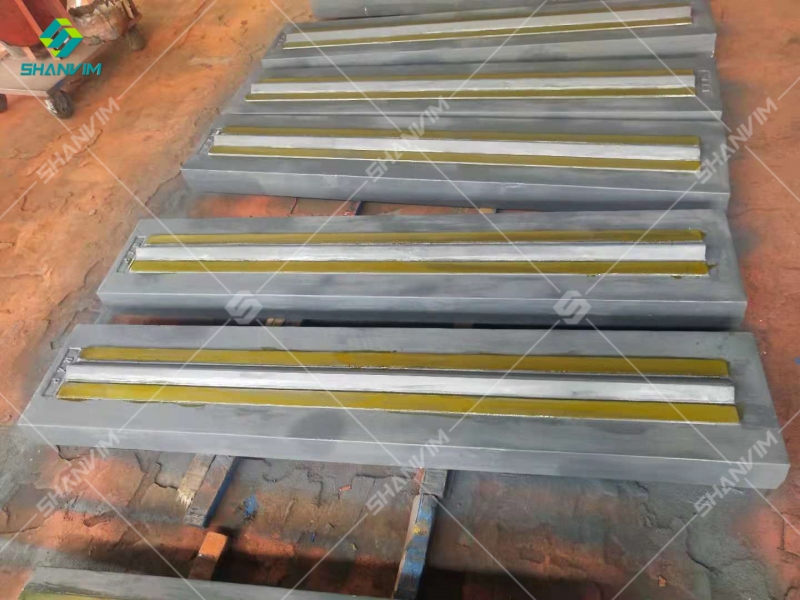
SHANVIM as a global supplier of crusher wearing parts, we manufacture cone crusher wearing parts for different brands of crushers. We have more than 20 years of history in the field of CRUSHER WEAR PARTS. Since 2010, we have exported to America, Europe, Africa and other countries in the world.
Post time: Jul-22-2026