
The Unsung Hero of Comminution: How Advanced Jaw Plate Technology Redefines Crushing Economics
JINHUA, China – In the harshest environments on Earth—from diamond mines in Africa to granite quarries in Europe—the initial breakdown of ore begins with a single, violent action: compression. At the heart of this process lies the jaw crusher, a brute-force machine that reduces rock from meters to millimeters.
However, the true hero of this operation is often overlooked until it fails: the Jaw Plate. Acting as the crusher’s teeth, these wear-resistant liners are the only interface between the machine and the rock. As the global demand for aggregates and minerals rises, industry leader SHANVIM is highlighting that optimizing jaw plate selection is the single most effective strategy to lower cost per ton and maximize uptime .
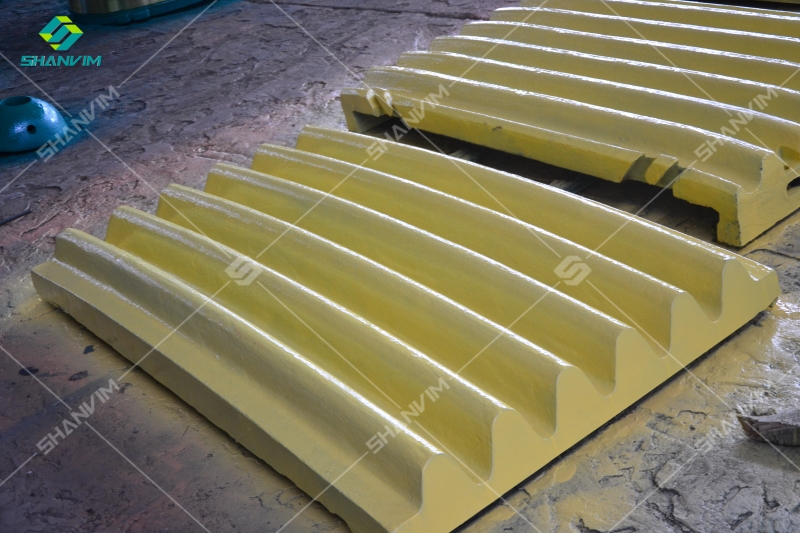
The Anatomy of Crushing: Fixed vs. Movable
To understand the value of a jaw plate, one must first understand the mechanics of the jaw crusher. The machine features two vertical jaws—one stationary (fixed jaw) and one eccentric (swing jaw)—forming a V-shaped crushing chamber .
The movable jaw plate executes a powerful elliptical stroke against the fixed plate. When rocks enter the chamber’s top, they are compressed, crushed, and broken apart. As the jaw opens, the material slides down to the bottom of the chamber for further reduction until it is small enough to escape through the discharge opening .
In this high-abrasion zone, jaw plates endure immense pressure, sliding friction, and impact. Without a scientifically engineered liner, crushers face premature wear, “belching” (material popping back out), and catastrophic structural failure .
Material Matters: The Metallurgy of Wear Resistance
According to SHANVIM’s engineering team, the “one-size-fits-all” approach to jaw plates is a costly mistake. While high manganese steel has been the industry standard for decades, the specific alloy grade must match the rock’s hardness and abrasiveness.
Here is how SHANVIM categorizes the modern material matrix for jaw plates:
1. Standard Manganese (Mn13Cr2)
The industry workhorse, Mn13 offers high toughness and impact resistance. It work-hardens under pressure—meaning the surface becomes harder as it is used. It is ideal for quarries processing limestone or medium-hard river gravel .
2. Heavy-Duty Manganese (Mn18Cr2)
For harder rock like granite, basalt, or porphyry, Mn18 provides a higher initial hardness and a superior work-hardening rate (up to 500 HBW). This grade resists deformation and cutting, offering extended life in high-tonnage settings .
3. Ultra-High Manganese & Hybrid Alloys (Mn22 / TiC)
For extreme applications involving quartzite, iron ore, or recycled concrete with steel rebar, SHANVIM recommends premium grades. Mn22 stabilizes the austenitic structure for deep hardening. In the most abrasive scenarios, Titanium Carbide (TiC) inserts are embedded into the manganese matrix, acting as hard “studs” that dramatically extend liner life—though they require strict impact control .
“Selecting the wrong alloy is like using a butter knife to chop wood,” said a SHANVIM metallurgist. “If the manganese is too soft, the plate flows like putty and wears out in weeks. If it’s too brittle for the application, it cracks. We analyze the customer’s feed to provide the exact recipe.”
Beyond Material: The Role of Profile Design
Material chemistry is only half the equation. The tooth profile dictates how the rock is gripped.
SHANVIM’s catalog includes a variety of profiles designed for specific outcomes:
Sharp Teeth (ST) / Corrugated: Ideal for hard, brittle rock requiring high compression.
Wide Teeth (WT): Designed for slabby materials, reducing slippage and increasing throughput.
Flat/Quarry profile: Suitable for recycling and softer stone, reducing unnecessary stress on the crusher frame .
The Hidden Cost of Wear: Nip Angle & Structural Fatigue
Worn jaw plates don’t just lose metal; they change the geometry of the crusher. As the teeth erode, the “Nip Angle”—the angle between the fixed and moving jaw—increases.
When the angle exceeds the optimal range (typically 18-22 degrees), the rock stops breaking and starts slipping. Operators often describe this as “belching,” where material shoots back out of the feed opening. This not only drops throughput by over 20% but increases vibration, accelerating fatigue on the eccentric shaft and pitman assembly .
SHANVIM engineers stress that waiting for a hole to appear in the jaw plate is waiting too long. The true indicator of replacement is the loss of profile geometry and increased discharge size.
Beyond the Jaw: The “Fuse” You Didn’t Know You Had
While promoting its own high-quality jaw plates, SHANVIM also warns against “upgrading” other components without engineering logic. The toggle plate is designed as a mechanical fuse—a sacrificial part that breaks when tramp metal (like a loader tooth) enters the crusher .
Replacing a cast iron toggle plate with a solid steel plate might stop the toggle from breaking, but it transfers that massive force ($F > 800$ tons) directly to the pitman or eccentric shaft. The result? A $40,000 pitman replacement instead of a $500 toggle plate .
SHANVIM: The Global Standard in Wear Parts
With over 30 years of specialized manufacturing experience, SHANVIM has positioned itself as a premier global supplier for the mining and aggregate industries . The company recently announced the dispatch of high-precision jaw plates for C Series models (including C116) and cone crusher mantles to markets across America, Europe, and Africa .
SHANVIM’s rigorous casting process—utilizing V-method and lost foam techniques—ensures density and dimensional accuracy. By maintaining strict ISO standards and offering a variety of alloys (Mn13, Mn18, Mn22, and Cr-Mo alloys), SHANVIM guarantees that its wear parts deliver a lower total cost of ownership compared to generic alternatives .
Conclusion
As Mining Indonesia 2025 and similar global exhibitions have shown, the industry is shifting from price-driven purchasing to value-driven engineering . The jaw plate is no longer just a “wear part”; it is a strategic tool.
By selecting the right material, profile, and supplier—like SHANVIM—operations can eliminate unplanned downtime, protect the crusher’s structural integrity, and ensure that the first stage of comminution remains the most efficient.
About SHANVIM
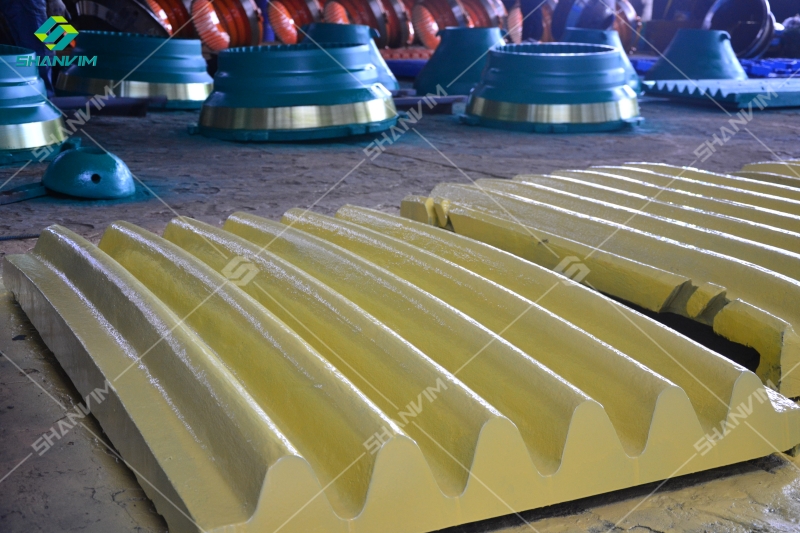
Headquartered in Jinhua, Zhejiang, SHANVIM is a leading manufacturer of high-quality crusher wear parts. With a history spanning over two decades, the company specializes in jaw plates, cone crusher mantles, blow bars, and mill liners engineered to maximize longevity and performance in the harshest crushing environments .
For more information, visit SHANVIM’s official website or contact their sales team for a customized liner profile recommendation.
Post time: Apr-09-2026