
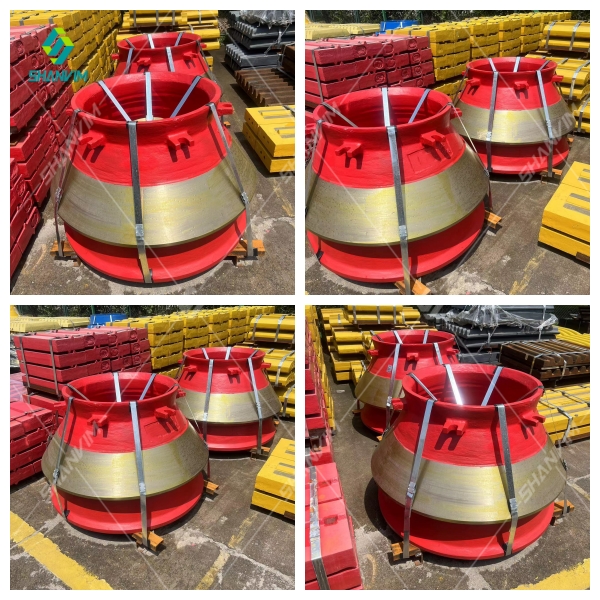
In the mining machinery, aggregate production, and metallurgical industries, the cone crusher serves as the core equipment for medium and fine crushing. Its stable operation directly affects the productivity and profitability of the entire production line. The concave (also known as the fixed cone liner), as a key wear component that withstands immense crushing forces within the cone crusher, operates under extremely harsh conditions. Once cracks or even fractures occur, it not only leads to equipment shutdowns and halved production capacity but can also trigger serious safety accidents, resulting in significant economic losses for the enterprise.
Regarding the persistent problem of cracks and fractures in concaves, a core question persists within the industry: Is this an “innate deficiency” caused by material issues, or “acquired maladjustment” due to improper operation? To delve deeper into this technical challenge, we interviewed several industry experts and specifically consulted the technical team of Zhejiang Jinhua Shanvim Industry And Trade Co., Ltd., a company with extensive experience in the field of wear-resistant castings. Their analysis indicates that concave failure is typically the combined result of material properties, operational maintenance, and working conditions, and cannot be simply attributed to a single factor.
I. In-depth Analysis: The Three Main Culprits Behind Concave Cracks and Fractures
To solve the problem, an accurate diagnosis is the first step. The factors leading to concave failure are complex and intertwined, but can be primarily summarized in the following aspects:
1. Material and Metallurgical Quality: The Invisible “Innate Defect”
Concaves are typically made of high manganese steel (such as ZGMn13, ZGMn18, etc.). Its core advantage lies in its “work hardening” characteristic. Under significant impact load, the surface rapidly hardens to resist wear, while the interior maintains excellent toughness. If there are issues with the material or casting process, cracks will follow.
Non-compliant Chemical Composition: The manganese-to-carbon ratio is crucial for the performance of high manganese steel. If the carbon content is too high, or the manganese content is insufficient, it leads to decreased plasticity and insufficient toughness, making the material prone to brittle cracks under impact. Conversely, if the ratio of key alloying elements is incorrect, the work-hardening ability weakens, leading to rapid surface wear and excessive stress on the base body, causing cracking.
Casting Defects (Structural Weaknesses): These are the most common “innate deficiencies.” They include subsurface blowholes, slag inclusions, shrinkage cavities, and porosity. Under powerful alternating stresses, these microscopic defects become points of stress concentration and rapidly expand into macroscopic cracks. A technical lead from Zhejiang Jinhua Shanvim Industry And Trade Co., Ltd. pointed out: “High-standard casting companies use X-ray inspection, ultrasonic testing, and other methods to check the internal quality of castings. However, many low-cost castings on the market often omit this crucial step, laying a huge hidden danger for subsequent use.”
Improper Heat Treatment Process: High manganese steel must undergo water toughening treatment at around 1100°C to obtain a single austenitic structure. If the heating temperature is insufficient, the holding time is too short, or the cooling rate is too slow, it can lead to carbide precipitation along the grain boundaries, drastically reducing the material’s toughness and impact resistance. Such liners often fracture within a short period after being put into service.
2. Operation and Maintenance: The “Human Factor” in Production
Often, high-quality concaves fail prematurely because the post-production usage environment exceeds their designed tolerance range.
Feeding Issues: This is the most common form of improper operation.
- Segregated Feeding: If the crusher operates in a “single-side feeding” state for a long time, one side of the concave bears excessive force while the other side is nearly unloaded. This uneven force generates eccentric load torque, which not only accelerates localized wear on the liner but also creates enormous abnormal stress on the loaded side,making the concave highly prone to cracking.
- Oversized Feed or Non-crushable Material: When the feed particle size exceeds the equipment’s design limits, or when materials like tramp iron or drill bits (“tramp metal”) enter the crusher, the concave experiences instantaneous ultra-high impact loads. If the crusher’s “tramp iron release” mechanism fails, this immense impact force can directly cause the concave to fracture.
Incorrect Setting of Crushing Chamber Parameters: Setting the closed side setting (CSS) too small significantly increases the crushing force. Materials are excessively squeezed within the crushing chamber, circulating loads increase, and the stress on the liner far exceeds the design value, making it highly susceptible to cracking.
Installation and Fastening Problems: The concave is fixed onto the adjustment ring using U-bolts or hydraulic locking systems. If the support surface is not cleaned properly before installation, or if the fastening torque is insufficient, the concave may shift or wobble during operation. This creates pounding and resonance between the concave and the support surface, eventually leading to fatigue cracks.
Neglecting Daily Inspections: Crack development follows a process of propagation from the microscopic to the macroscopic level. If operators fail to detect early signs like fine cracks, abnormal noises, or rising oil temperatures in time, they miss the optimal maintenance window, ultimately leading to catastrophic fracture accidents.
3. Working Conditions and Equipment Matching: The Unavoidable “Environmental Challenge”
Equipment Aging: Problems with the crusher mainframe itself, such as severe wear of the main shaft eccentric sleeve or damage to the thrust bearing, can lead to uneven distribution of crushing forces, transmitting additional stress to the concave.
Material Characteristics: The harder and denser the material being crushed (e.g., high-silica iron ore), the greater the crushing work required. If the material grade of the selected concave does not match the hardness of the feed material, premature failure is likely.
II. The Solution: From “Reactive Repair” to “Proactive Prevention”
Faced with this complex technical challenge, how should companies respond? Should they focus on selecting high-quality suppliers, or strictly standardize operational procedures? In this regard, Zhejiang Jinhua Shanvim Industry And Trade Co., Ltd. (Shanvim) offers its professional insights and practical solutions.
As an enterprise dedicated to the R&D and manufacturing of wear-resistant parts for mining machinery, Shanvim believes that the core solution to the concave crack problem lies in “precise matching” and “whole-process control.”
Strictly Control Material and Process (Solving “Innate Deficiencies”)
Shanvim’s technical team emphasizes that a high-quality concave starts with scientific material formulas and strict process control. Tailored to different customers’ ore hardness, reduction ratios, and equipment models, Shanvim provides customized alloy proportioning solutions, such as adding rare metals like chromium, molybdenum, and nickel to refine grains and improve the material’s comprehensive mechanical properties. Simultaneously, they utilize advanced simulation casting systems to optimize gating and riser designs, minimizing casting defects like shrinkage cavities and porosity. Strict “water toughening treatment” processes and online non-destructive testing ensure that every concave shipped possesses excellent impact toughness and work-hardening ability.
Provide Professional Technical Support (Solving “Improper Operation”)
“What we sell to our customers is not just a casting, but a complete solution,” stated a sales manager from Shanvim. Addressing improper operation issues, Shanvim’s technical team visits customer sites to guide correct installation procedures, ensuring close fit between the concave and the support surface, and that locking torque meets standards. They also assist customers in optimizing the feeding method for the crushing chamber to ensure “full feeding and even distribution,” avoiding segregated wear. Through regular return visits, they help customers establish inspection mechanisms to identify and mitigate potential risks promptly.
Strengthen Design and Working Condition Matching (Solving “Environmental Challenges”)
For different working conditions, Shanvim optimizes the concave’s tooth profile (e.g., standard tooth, fine tooth, coarse tooth). When crushing exceptionally hard materials, they recommend that customers use higher manganese content grades or materials modified through special treatments to ensure the liner generates sufficient work hardening layer to resist both wear and impact.
Conclusion
In summary, cracks and fractures in concaves can stem from material issues, improper operation, or, more often than not, a combination of both “natural” and “human” factors. Simply assigning blame does not help solve the problem. Only by adopting a systematic approach—focusing on the three dimensions of high-quality wear material supply, scientifically standardized equipment operation, and professional timely maintenance—can such accidents be fundamentally prevented.
In this regard, professional foundry enterprises like Zhejiang Jinhua Shanvim Industry And Trade Co., Ltd. (SHANVIM), through continuous technological innovation and customer-centric service, are providing safer, more efficient, and more durable solutions for the global mining and engineering machinery industry, helping partners achieve true cost reduction, efficiency improvement, and safe production.
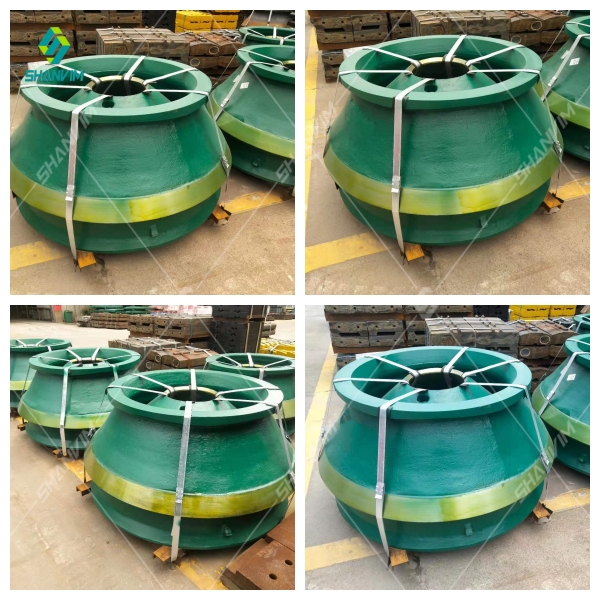
SHANVIM as a global supplier of crusher wearing parts, we manufacture cone crusher wearing parts for different brands of crushers. We have more than 20 years of history in the field of CRUSHER WEAR PARTS. Since 2010, we have exported to America, Europe, Africa and other countries in the world.
Post time: Feb-26-2026