
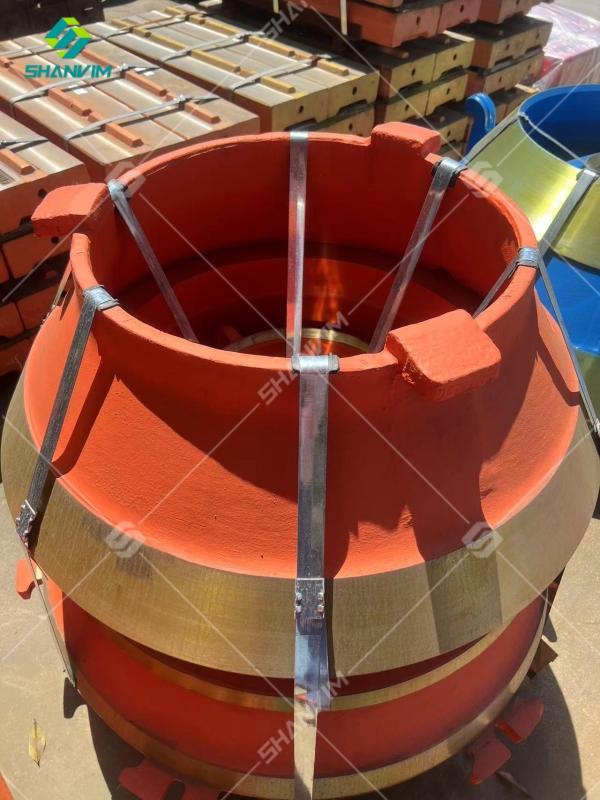
As the mining machinery industry continuously raises performance requirements for wear parts of crushing equipment, the heat treatment technology for core wear components of cone crushers—the mantle and concave—has become a key technical focus for major manufacturing enterprises. As the critical process determining the final performance of wear castings, heat treatment directly affects the service life, wear resistance, and impact resistance of mantle and concave components . This article systematically reviews current mainstream heat treatment technologies both domestically and internationally, providing technical references for industry peers.
1. Heat Treatment Process System for High Manganese Steel
The most commonly used material for mantle and concave is high manganese steel (typical grades: Mn13, Mn18Cr2, Mn22Cr2), whose unique work-hardening characteristics provide excellent wear resistance under high-impact conditions . The heat treatment processes for high manganese steel mainly include the following two methods:
1.1 Water Toughening Treatment
Water toughening treatment is the most fundamental heat treatment process for high manganese steel. The principle involves heating the steel above the AC1 temperature (typically 1050°C-1100°C) and holding for sufficient time to completely dissolve carbides in the as-cast structure, obtaining a uniform single-phase austenite structure, followed by rapid water quenching to obtain a supersaturated austenite solid solution .
Key Process Parameters:
Heating control: Hold at 150°C for 1 hour, then increase temperature at 60-100°C/hour
Intermediate holding: Hold at 650°C for 2-3 hours
Solution temperature: Heat to 1080-1100°C and hold; holding time calculated as 1 hour per 25mm of casting thickness, typically 4-5 hours total
Quenching control: Water temperature controlled at 20-30°C; time from furnace discharge to water immersion ≤45 seconds; castings should be moved up/down and left/right after immersion to break through the steam film and improve cooling effect
2. Precipitation Strengthening Heat Treatment
Precipitation strengthening heat treatment involves precipitating dispersed second-phase carbides in the austenite matrix through heat treatment, strengthening the matrix and improving the material’s resistance to abrasive wear . For modified high manganese steel containing alloying elements such as chromium and molybdenum, precipitation strengthening treatment is particularly critical.
Typical Process Route:
Heat to 600°C and hold for 12 hours (allowing full eutectoid transformation and carbide spheroidization)
Reheat to 1080°C and hold for 2 hours
Water quenching
Research shows that modified high manganese steel concaves treated with this process can achieve 1.3-1.5 times longer service life than ordinary high manganese steel, with significantly increased ore processing capacity .
2. Gradient Heat Treatment and Cryogenic Treatment Technologies
In recent years, with advances in materials science, gradient heat treatment and cryogenic treatment technologies have been applied in the manufacturing of mantle and concave components.
2.1 Gradient Heat Treatment
Gradient heat treatment achieves ideal microstructure distribution in castings by precisely controlling temperature profiles during heating, holding, and cooling stages. For thick and large castings like mantle and concave, gradient heat treatment effectively eliminates internal stress and prevents quenching cracks .
2.2 Cryogenic Treatment
Cryogenic treatment (typically below -100°C), as a supplementary process to heat treatment, can further refine carbide distribution and promote transformation of retained austenite to martensite, increasing material hardness by approximately 15% . High manganese steel treated with cryogenic processing shows significantly improved wear resistance, particularly suitable for processing highly abrasive materials such as basalt and quartzite .
3. Heat Treatment Innovations for Composite Materials
3.1 Bimetal Composite Heat Treatment
Bimetal composite mantle components combine an outer layer of high-chromium cast iron (wear-resistant layer) with an inner layer of high-toughness steel (such as high manganese steel or low-carbon steel) . This material combination imposes higher requirements on heat treatment processes—maintaining good toughness in the inner layer while ensuring high hardness in the outer layer.
3.2 Ceramic-Reinforced Metal Matrix Composites
Latest technological advances show that ceramic-reinforced metal matrix materials (with ceramic in honeycomb structure) applied to the working surface of concaves can significantly enhance wear resistance . Heat treatment for such composite materials must balance the phase transformation behavior of the metal matrix with the thermal stability of the ceramic phase, typically requiring high-precision temperature control equipment to avoid interface cracking caused by thermal stress .
4. Heat Treatment Equipment Technology Upgrades
Modern heat treatment for mantle and concave commonly utilizes advanced circular bell-type trolley electric furnaces, offering advantages such as good sealing, environmental friendliness, energy efficiency, and reduced casting decarburization . Such equipment enables precise furnace temperature control and programmable heating/holding/cooling curves, meeting the requirements of complex heat treatment processes.
Meanwhile, the development of digital heat treatment workshops enables real-time monitoring and full traceability of process parameters, providing strong guarantees for product quality consistency.
Conclusion
Heat treatment technologies for mantle and concave are evolving toward precision, hybridization, and intelligence. From traditional water toughening to precipitation strengthening heat treatment, and further to cryogenic treatment and composite material heat treatment innovations, each technological advancement drives continuous improvement in the performance of crusher wear parts. In the future, with the continuous emergence of new materials and processes, heat treatment technology will play an increasingly critical role in the manufacturing of mining machinery wear components.
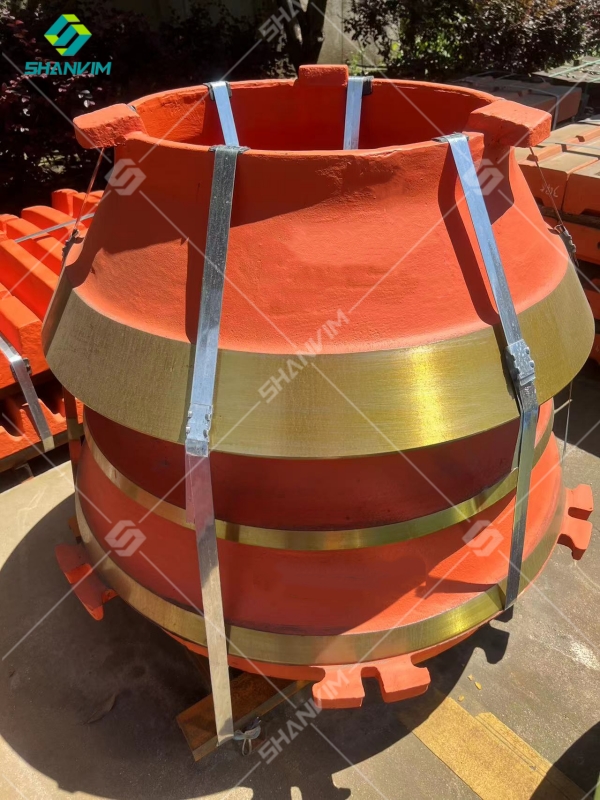
SHANVIM as a global supplier of crusher wearing parts, we manufacture cone crusher wearing parts for different brands of crushers. We have more than 20 years of history in the field of CRUSHER WEAR PARTS. Since 2010, we have exported to America, Europe, Africa and other countries in the world.
Post time: Mar-18-2026