
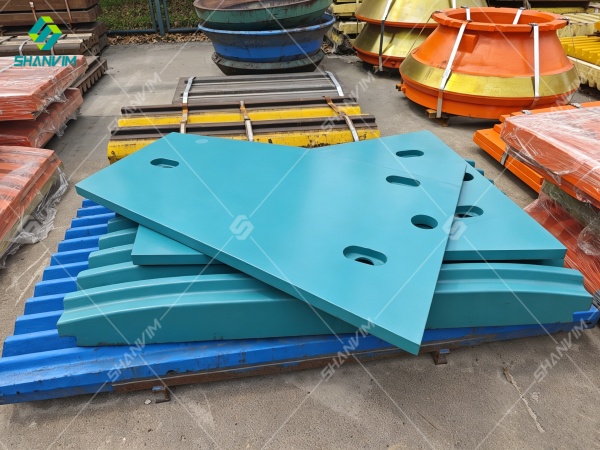
In the heavy duty world of crushing, whether it is a jaw crusher, a gyratory crusher or an impactor, the cheek plate plays an outsized role in protecting the crusher frame from material abrasion. Cheek plates, often called side liners or cheek liners, are mounted on the inner side walls of the crushing cavity. Their job is simple but critical: stop crushed rock or ore from grinding directly against the crusher main frame.
Yet this component is frequently overlooked during routine wear inspections. So the question every quarry operator and maintenance manager needs answered is this: How worn is too worn? At what exact point must a cheek plate be replaced?
SHANVIM, a leading supplier of crusher wear parts, has compiled field data and OEM-based best practices to give you a clear, practical answer. This article provides a complete guide to cheek plate replacement standards, helping you avoid unnecessary liner waste and catastrophic frame damage.
Why Cheek Plate Wear Matters More Than You Think
A cheek plate that wears through is not just a worn part. It becomes a direct threat to your crusher’s structural integrity. Once the plate is perforated, highly abrasive material will erode the frame itself. Replacing or repairing a crusher frame costs 20 to 50 times more than a simple cheek plate change-out.
Beyond frame protection, worn cheek plates cause three hidden problems. First, they affect material flow. Uneven side walls create bridging and packing inside the crushing chamber, reducing throughput. Second, they interfere with crusher setting measurements by giving false references for closed side setting. Third, they accelerate wear on jaw dies or mantle and concave liners, forcing you to replace those expensive parts sooner than necessary.
According to SHANVIM’s field engineers, ignoring cheek plate wear is one of the most common and costly mistakes in crushing plant maintenance.
The Universal Replacement Rule: The 15 Millimeter Threshold
Across leading crusher manufacturers SHANVIM’s own testing, the consensus is not a single percentage but a structural limit. Replace the cheek plate when the remaining thickness at its thinnest point is 15 to 20 millimeters, which is roughly 0.6 to 0.8 inches, or when any hole or perforation has worn completely through the plate.
In practice, SHANVIM recommends the following guidelines based on duty conditions. For light to medium duty applications such as limestone or gravel, replace when the cheek plate has worn through or when the remaining thickness falls below 10 to 12 millimeters at the center of the plate. For heavy duty applications such as granite, basalt or iron ore, replace when the thinnest point reaches 15 to 20 millimeters. High impact materials accelerate frame damage, so a thicker remaining section is required for safety.
SHANVIM calls this the 15 millimeter rule. It is simple, easy to measure and proven to balance liner life against frame protection.
Why the Thirty Percent Weight Loss Rule Is Not Enough
Some older maintenance manuals state a 30 to 40 percent weight loss as a replacement criterion. SHANVIM acknowledges that this is a valid secondary indicator, but it is impractical for field decisions. Very few sites have the ability to weigh liners during production. Weight loss also does not tell you where the wear is concentrated.
A cheek plate typically fails first in the lower middle section, directly opposite the crushing zone. A plate might lose only 25 percent of its weight but already have a localized hole near the bottom. If you rely on weight loss alone, you will miss that hole and damage your frame. SHANVIM therefore recommends visual and thickness checks as the primary methods, with weight loss as a backup reference only.
Five Visual Indicators That Say Change Now
SHANVIM’s field service team has trained hundreds of crusher crews to watch for five specific visual signs. These indicators do not require any special tools.
The first sign is holes or cracks exposing the frame. This requires an immediate stop and replacement before any further crushing takes place. No exception.
The second sign is the ribbed pattern completely gone, leaving a smooth surface. When the original cast or rolled pattern has disappeared, the plate has lost most of its wear material. Replace it within two shifts.
The third sign is thickness measured at the lowest point of the plate being less than 15 millimeters. Use a simple thickness gauge or even a bent wire through a small drilled hole. When you see this, schedule replacement at the next available downtime.
The fourth sign is severe step wear, where the difference from top to bottom is more than 25 millimeters. This indicates uneven feed distribution. Replace the cheek plate and also check and correct your feed chute or feeder.
The fifth sign is when weld buildup is no longer possible because the base metal thickness has fallen below 10 millimeters. Some operators try to extend liner life by welding hardfacing onto worn cheek plates. SHANVIM advises that once the base metal is below 10 millimeters, welding becomes dangerous and ineffective. Discard the plate and fit a new one.
Case Study: A 600 Ton Per Hour Jaw Crusher in Granite
SHANVIM recently supported a granite quarry in Norway that tracked cheek plate wear over 12 months. The OEM cheek plates had an original thickness of 20 millimeters. They were replaced after 3,200 hours when the remaining thickness fell to 18 millimeters, still above the 15 millimeter guideline but close enough to justify a proactive change.
However, one cheek plate suffered a localized wear hole at 2,800 hours due to a protruding bolt head. That side was replaced immediately, while the opposite side ran another 400 hours. The key lesson from this case is that uniform wear is rare. SHANVIM recommends checking both cheek plates individually. Do not assume they wear at the same rate.
The Economics: Changing Too Early Versus Too Late
SHANVIM has calculated the financial impact of wrong replacement timing. Changing a cheek plate too early, for example at 25 millimeters remaining instead of 15 millimeters, wastes about 40 percent of liner life. For a 200 dollar cheek plate, that is 80 dollars lost every change-out. Over 10 changes, that is 800 dollars, which is the cost of four spare cheek plates.
Changing too late is far more expensive. Frame damage repair typically costs between 15,000 and 40,000 dollars, plus extended downtime of two to five days. In lost production, a 600 ton per hour crusher down for three days at 50 dollars per ton loses 216,000 dollars in output. A single frame repair event can easily exceed a quarter million dollars in total costs.
The optimum economic point according to SHANVIM is to run the cheek plate until the 15 millimeter remaining thickness threshold, not a day more and not a day less. This gives you the maximum liner life while maintaining a safety margin for the frame.
How to Measure Cheek Plate Wear Without Expensive Tools
SHANVIM teaches two practical methods for field measurement. The first is the drill method. Drill a small hole of two to three millimeters at the suspected thinnest spot. This is only allowed when the crusher is shut down and locked out. Insert a bent wire into the hole to feel the remaining thickness. Mark that depth on the wire and measure it with a ruler.
The second method is the comparison method. Hold a straightedge across the surface of a new cheek plate. Then place the same straightedge against the worn plate at the same position. The gap at the middle is roughly the worn away thickness. Subtract that gap from the original plate thickness to get the remaining thickness.
Wear Patterns and What They Tell You
SHANVIM’s engineers have identified four common wear patterns and their causes. A normal wear pattern is even or slightly heavier at the lower half of the cheek plate. This indicates correct feed distribution. No action is needed beyond routine monitoring.
Severe top wear only means that feed is falling directly onto the top of the cheek plate. Install feed deflectors or adjust the feed chute to solve this problem.
One side worn more than the other indicates off center feeding. Adjust the chute or feeder to center the material flow. A washboard or rippled surface indicates material packing or vibration resonance. Check crusher speed and material moisture. If abnormal patterns appear before the 15 millimeter threshold is reached, replace the cheek plate anyway and correct the root cause before installing the new one.
SHANVIM’s Summary Table in Words
Here is a simple summary for field use. If remaining thickness is more than 30 millimeters, monitor monthly. Priority is low. If thickness is between 20 and 30 millimeters, inspect weekly. Priority is medium. If thickness is between 15 and 20 millimeters, plan replacement at the next scheduled downtime. Priority is high. If thickness is less than 15 millimeters, replace immediately. Priority is critical. If any hole has worn through the plate, stop the crusher and replace before restart. This is an emergency. If a crack extending more than 50 millimeters along the edge is found, replace within eight hours. Priority is high.
Final Advice from SHANVIM
A maintenance manager from a Canadian iron ore site once told SHANVIM, if you see daylight through a cheek plate, you are already late. But if you wait until it is completely gone, you are not a maintenance hero. You are a frame repair customer.
SHANVIM’s recommendation is clear. Set your alarm at 15 millimeters remaining thickness. Use a thickness gauge once per week during production. Replace the cheek plate proactively during your next planned liner change. Cheek plates are sacrificial wear parts. They are meant to be replaced. Let them do their job fully, but never at the expense of your crusher’s structural integrity.
In short, replace when worn to approximately 15 millimeters thickness or when you see any hole. Anything earlier wastes money. Anything later destroys the frame.
For more maintenance guidelines and high quality crusher wear parts, visit SHANVIM.
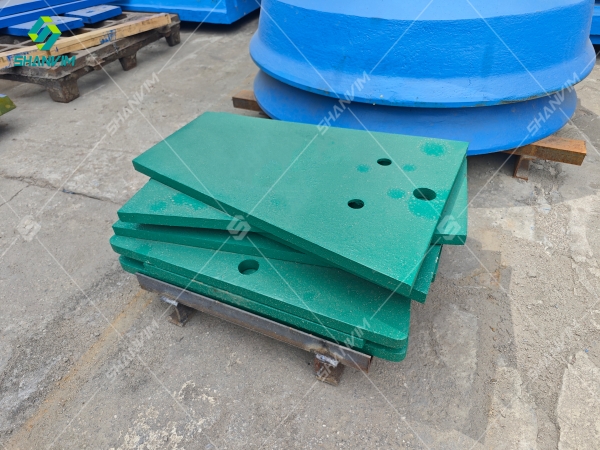
SHANVIM as a global supplier of crusher wearing parts, we manufacture cone crusher wearing parts for different brands of crushers. We have more than 20 years of history in the field of CRUSHER WEAR PARTS. Since 2010, we have exported to America, Europe, Africa and other countries in the world.
Post time: May-21-2026