
How to Judge the Need for Replacement: Three Key Signs
Before regular inspections, if the following signs appear during daily operation, it usually indicates that jaw plate wear has reached a level requiring attention:
Significant Drop in Production Efficiency: Under identical feeding conditions, the crusher’s processing capacity (tons per hour) continuously decreases, and energy consumption per unit of output increases.
Deterioration and Inconsistency in Product Size: The proportion of oversized material not meeting specifications in the discharge increases, and the particle size distribution curve changes. This may be due to altered effective crushing chamber geometry caused by worn jaw plates.
Abnormal Vibration and Noise: Unevenly worn jaw plates can lead to imbalanced crushing forces, causing abnormal vibration and noise. Long-term operation under these conditions can damage core components like bearings and the frame.
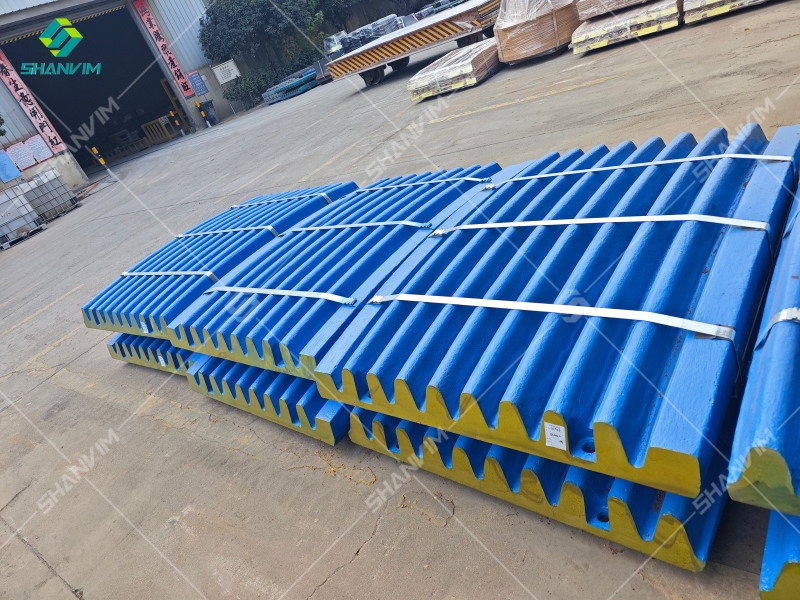
Specific Criteria for Jaw Plate Wear and Replacement
When the above signs appear, the machine should be stopped for professional inspection. The replacement decision should be based on the following specific, quantifiable standards:
1. Tooth Height Wear: The Core Metric
The industry commonly uses the wear proportion of the tooth tip height as the primary evaluation criterion. It is recommended to adopt a graded warning management system:
Observation Phase (Wear Rate < 15%): This is the normal wear stage. Strengthen daily inspections and record wear progress.
Key Monitoring Phase (Wear Rate 15% – 30%): Wear enters an accelerated period. Shorten the inspection cycle and begin planning for spare parts. Some industry maintenance standards indicate that evaluation becomes critical when the number of teeth with wear exceeding 25% of their original height reaches 45% of the total teeth.
Recommend Replacement (Wear Rate > 30%): Wear is very severe at this stage. Crushing efficiency is significantly reduced, and the discharge opening is difficult to adjust properly. Replacement must be scheduled. Continued use risks issues like liner loosening and a sharp drop in production.
2. Wear Uniformity Check
In addition to measuring the average wear rate, the uniformity of wear across the jaw plate must be checked. If localized severe pitting, cracking, or loss of profile (over half the teeth worn flat and losing their edges) occurs, replacement should be considered even if the overall average wear rate is not fully exceeded. This ensures stable crushing force and uniform product size.
3. Reference to National Standards
For compound pendulum jaw crushers, the national recommended standard “GB/T 25702-2010 Compound Pendulum Jaw Crusher – Jaw Plate Wear” clearly defines the terminology, evaluation methods, and grading for jaw plate wear. This standard provides unified technical basis for equipment manufacturers, users, and inspection institutions. It should be followed for scientific assessment during major overhauls or third-party inspections.
Regarding the material selection and manufacturing of wear-resistant parts, professional foundry enterprises like SHANVIM possess extensive experience. The company specializes in producing wear-resistant materials, with its product line covering series such as high manganese steel and alloy steel. Utilizing processes like lost foam casting and sand molding, the company is committed to enhancing the density, dimensional accuracy, and wear uniformity of castings, ensuring component quality from the source.
In summary, determining jaw plate replacement requires “observing phenomena, measuring data, and adhering to standards.” Establishing a regular inspection and recording system, combined with the actual operational performance of the equipment, allows for the most economical and safe replacement decisions.
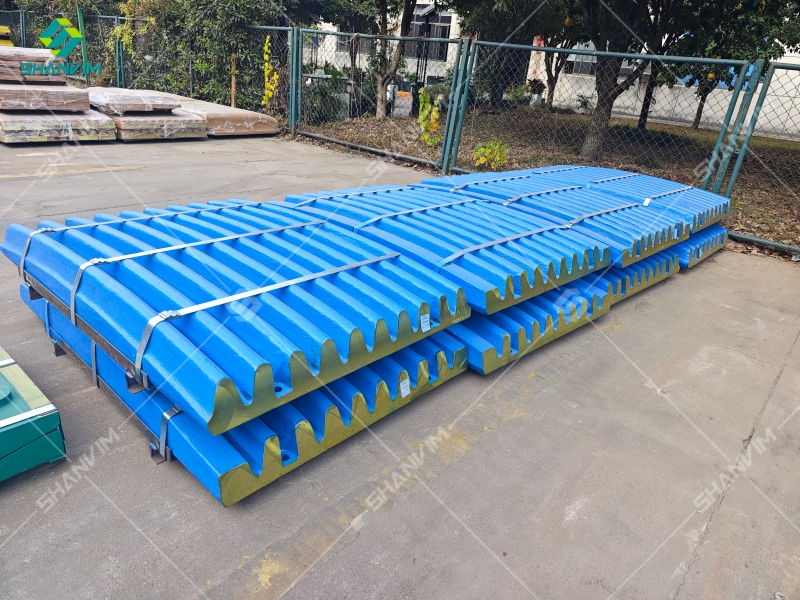
SHANVIM as a global supplier of crusher wearing parts, we manufacture cone crusher wearing parts for different brands of crushers. We have more than 20 years of history in the field of CRUSHER WEAR PARTS. Since 2010, we have exported to America, Europe, Africa and other countries in the world.
Post time: Jan-27-2026