
Introduction
Walk into any quarry, mining site, or demolition yard, and you will likely hear the powerful, rhythmic pounding of a jaw crusher at work. This machine is the workhorse of the aggregate and mining industries, responsible for taking massive rocks and reducing them to manageable sizes.
But while the crusher frame, flywheel, and eccentric shaft are essential, there is one set of components that literally does the heavy lifting: the jaw plates.
At SHANVIM, with over 30 years of experience manufacturing high-quality crusher wear parts, we know that jaw plates are the unsung heroes of crushing operations. Without them, your crusher is just an expensive steel frame. With the right jaw plates, your operation runs efficiently, productively, and profitably.
This article explains exactly what jaw plates are, how they function, what materials go into them, and why choosing the right manufacturer matters.
1. What Are Jaw Plates? Defining the Component
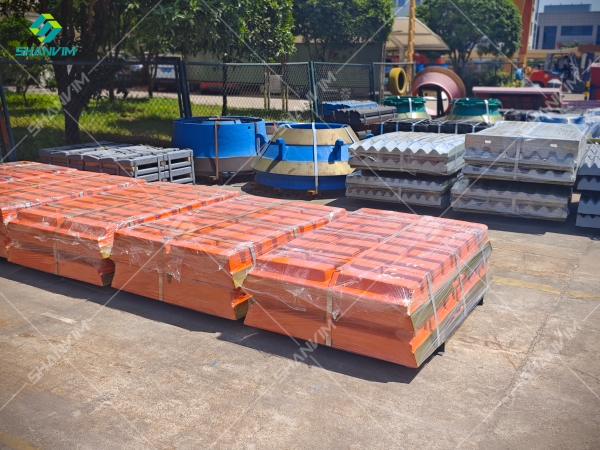
A jaw crusher, as the name suggests, works like a pair of mechanical jaws. It uses two vertical steel plates to crush material between them. These plates are called jaw plates or sometimes jaw dies.
The Two Types of Jaw Plates:
Fixed Jaw Plate (Stationary Jaw): This plate is mounted on a stationary position within the crusher frame. It does not move. Instead, it acts as the anvil against which the rocks are crushed.
Swing Jaw Plate (Moving Jaw): This plate is attached to the moving jaw assembly. Driven by the eccentric shaft and toggle mechanism, it moves back and forth in a controlled, elliptical motion.
The Tooth Pattern
Most jaw plates are not flat. Instead, they feature a series of raised ridges and recessed valleys, commonly referred to as “teeth.” These teeth serve a very specific purpose: they grip the rock, concentrate crushing force, and help pull material down through the crushing chamber.
When installed correctly, the teeth of the fixed jaw plate align with the valleys of the swing jaw plate, and vice versa. This creates an interlocking, zigzag crushing cavity that optimizes both compression and throughput.
In short, jaw plates are the replaceable, wear-resistant surfaces that directly contact and crush the material entering the crusher.
2. What Is the Role of Jaw Plates? Understanding Their Function
The primary function of jaw plates is simple to state but complex to execute: to crush rocks and other hard materials efficiently while protecting the crusher frame from damage.
Let us break down this role into four specific functions.
Function One: Material Compression
The jaw crusher is a compression-type crusher. As the swing jaw plate moves toward the fixed jaw plate, the space between them – known as the crushing chamber – narrows. Rocks trapped between the plates are subjected to immense compressive forces, causing them to fracture from the inside out. Without jaw plates, there would be no surface to apply this force.
Function Two: Material Gripping and Feeding
The teeth on the jaw plates are not just for crushing. They also grip the rocks, preventing them from sliding upward or out of the chamber. As the swing jaw pulls away, the teeth release their grip, allowing crushed material to fall downward by gravity. Then, as the jaw moves forward again, the teeth grab the next layer of material. This cycle creates a continuous, self-feeding action.
Function Three: Product Size Control
The gap at the bottom of the jaw plates – called the closed side setting (CSS) – determines the maximum size of the crushed product. By adjusting this gap, operators can control whether the crusher produces coarse gravel or finer aggregate. The jaw plates wear over time, affecting this gap, which is why regular monitoring and timely replacement are essential.
Function Four: Protecting the Crusher Frame
This final function is often overlooked. Jaw plates are designed as sacrificial wear parts. They are made from hard, abrasion-resistant materials so that they wear down instead of the crusher frame. Replacing a set of jaw plates is routine maintenance. Replacing a cracked crusher frame is a catastrophe. In this sense, jaw plates are the first and most important line of defense for your equipment investment.
3. How Do Jaw Plates Wear? Understanding the Failure Mechanisms
Nothing lasts forever, and jaw plates are no exception. In fact, they are designed to wear out. Understanding how they wear can help you predict replacement intervals and avoid unexpected downtime.
Micro-Cutting (Abrasion)
As rocks slide down the crushing chamber, they act like a file. Hard particles scratch and cut microscopic grooves into the surface of the jaw plates. Over time, these tiny scratches accumulate, gradually removing material from the plate surface. This is especially aggressive when crushing highly abrasive materials like granite, basalt, or river pebbles.
Plastic Deformation (Peening)
The repeated high-impact hammering of rocks against the jaw plates causes the surface layer of the metal to flatten or “smear.” This is known as plastic deformation. You can often identify this type of wear by looking at the tooth peaks: if they appear shiny, polished, or flattened, plastic deformation has occurred.
Fatigue Spalling
After thousands or millions of crushing cycles, microscopic cracks begin to form just beneath the surface of the jaw plate. These cracks slowly grow and connect with one another. Eventually, small chips or even large chunks of the tooth plate break off suddenly. This is called spalling, and it signals that the jaw plate has reached the end of its useful life.
The Wear Pattern
Critically, jaw plates do not wear evenly. The lower section of the plates – near the discharge opening – wears significantly faster than the upper section. Why? Because the gap is smaller at the bottom, the compressive forces are higher. Additionally, the material at the bottom has already been partially crushed, making it sharper and more abrasive.
To address this, SHANVIM offers symmetrical jaw plates. When the bottom section wears out, you can simply rotate the plate 180 degrees and continue using the fresh top section. This simple design feature can effectively double the service life of your jaw plates.
4. What Materials Are Jaw Plates Made Of? The Science of Wear Resistance
You cannot make jaw plates from ordinary structural steel. It would deform instantly. Instead, jaw plates are cast from specialized alloys designed to resist both impact and abrasion.
Austenitic Manganese Steel – The Industry Standard
For over a century, austenitic manganese steel has been the material of choice for jaw crusher plates. Its secret lies in a property called work hardening.
When first installed, manganese steel is relatively soft and ductile, with a hardness of approximately 200 to 250 BHN (Brinell Hardness Number). However, each time a rock impacts the surface, the metal instantly hardens. After sufficient impact, the working surface can reach hardness levels of 500 BHN or more. The interior of the plate remains tough and ductile, absorbing shock without cracking.
Mn13Cr2 – The Classic Alloy
The most commonly used manganese steel grade is Mn13, which contains approximately 13% manganese and 1.2% carbon. This alloy offers an excellent balance of initial toughness and work-hardening capacity. For most quarry and recycling applications, Mn13 jaw plates provide reliable, cost-effective performance.
Mn18Cr2 – For High-Impact Applications
When crushing extremely hard or large rocks – such as granite, basalt, or iron ore – the impact forces are much higher. In these conditions, SHANVIM recommends Mn18Cr2 alloy. This grade contains 18% manganese and 2% chromium. The chromium addition enhances the hardness of the work-hardened layer, providing superior resistance to gouging and micro-cutting compared to standard Mn13.
Titanium Composite Plates – The Premium Solution
For the most extreme applications, where every hour of downtime costs a fortune, SHANVIM offers titanium carbide composite jaw plates. By embedding titanium alloy inserts into the high-wear zones – the tooth peaks – we combine the impact resistance of manganese steel with the extreme hardness of aerospace-grade materials. These plates are the ultimate solution for customers focused on minimizing cost per ton of crushed material.
5. Why Choose SHANVIM? Over 30 Years of Casting Excellence
Knowing what jaw plates are and what they do is one thing. Obtaining high-quality, reliable jaw plates is another matter entirely. This is where SHANVIM’s three decades of experience make all the difference.
Decades of Specialization
SHANVIM has been manufacturing crusher wear parts for over 30 years. We are not a general foundry that occasionally makes jaw plates. We are a specialized wear parts manufacturer. Every process in our facility – from pattern design to heat treatment – is optimized specifically for crusher components.
Precision Casting
A jaw plate that does not fit properly against the crusher frame is dangerous. Poor fit leads to cracking, uneven wear, and even catastrophic failure. SHANVIM uses advanced casting techniques – including V-process molding and water glass sand casting – to achieve tight dimensional tolerances. Our plates fit correctly the first time, every time.
Heat Treatment Mastery
Casting the plate is only half the battle. The heat treatment process – specifically water toughening or quenching – determines the final metallurgical properties. At SHANVIM, we heat our castings to precisely 1,050 degrees Celsius and then rapidly cool them in water. This controlled process ensures a uniform austenitic structure without brittle carbides at the grain boundaries, maximizing the work-hardening potential of the steel.
Global Supply Capability
When your jaw plates break unexpectedly, you cannot afford to wait weeks for a replacement. SHANVIM maintains a robust inventory of common sizes, ready for immediate dispatch. We regularly ship container loads of critical spares to customers across North America, Europe, Africa, and Southeast Asia.
Custom Solutions
No two crushing operations are identical. Different rock types, feed sizes, and desired outputs demand different jaw plate designs. SHANVIM offers custom tooth patterns, alloy selections, and even composite insert placements to match your specific application. We work with you to optimize your jaw plates for maximum uptime and lowest cost per ton.
Conclusion
The jaw plate is far more than a simple piece of metal. It is a precisely engineered tool that converts mechanical energy into crushing force, grips and feeds material automatically, controls product size, and sacrifices itself to protect the crusher frame.
Without jaw plates, a jaw crusher cannot function. With worn or poorly manufactured jaw plates, a crusher operates inefficiently, costing you money in reduced throughput, increased fuel consumption, and unplanned downtime.
With the right jaw plates – properly designed, correctly cast, and matched to your material – your jaw crusher becomes a reliable, productive asset that drives your entire operation.
At SHANVIM, with over 30 years of experience in the crusher wear parts industry, we take jaw plates seriously. We combine traditional foundry craftsmanship with modern metallurgical science to deliver products that perform, endure, and protect your investment.
Whether you are crushing granite in a quarry, recycling concrete in a demolition yard, or processing ore in a mine, SHANVIM has the jaw plates you need. Our commitment to quality, precision, and customer service has made us a trusted partner for crushing operations around the world.
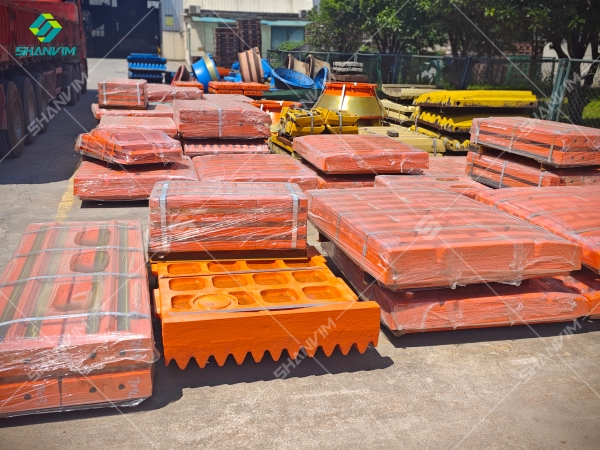
SHANVIM as a global supplier of crusher wearing parts, we manufacture cone crusher wearing parts for different brands of crushers. We have more than 20 years of history in the field of CRUSHER WEAR PARTS. Since 2010, we have exported to America, Europe, Africa and other countries in the world.
Post time: May-14-2026