
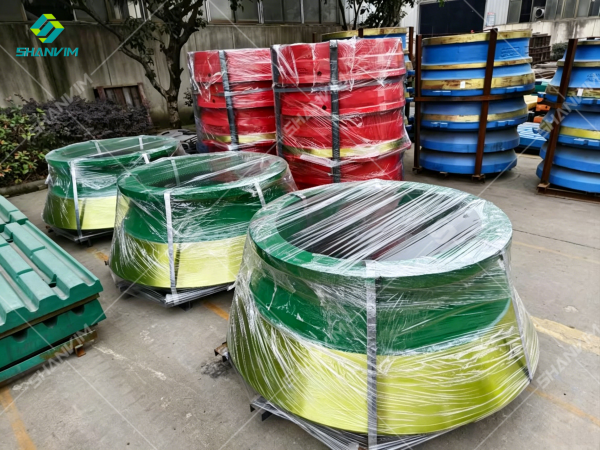
In the actual working conditions of cone crushers, the mantle (moving cone liner) typically wears faster than the bowl liner (stationary cone liner). This conclusion is supported by the motion trajectories, force characteristics, and industry field data of the two components.
A Comparative Analysis of Wear Behavior in Cone Crushers
In cone crushing operations, one of the most frequently debated maintenance questions is deceptively simple: between the mantle (moving cone liner) and the bowl liner (stationary cone liner), which one actually wears faster? The answer matters enormously for spare-parts planning, maintenance scheduling, and cost control. Based on motion analysis, stress distribution, and field service data, the evidence points to a clear conclusion — the mantle generally wears faster than the bowl liner, though the picture is more nuanced than a simple verdict.
The Mantle: More Complex Motion, Greater Cumulative Wear
The mantle is mounted on the moving cone, which is driven by an eccentric sleeve to perform a gyratory swinging motion. This means the mantle continuously oscillates relative to the bowl liner — approaching it on one side while receding on the other, squeezing and crushing material in the process. This continuous, complex three-body abrasive wear condition subjects the mantle surface to both enormous compressive forces and shear stresses simultaneously.
Research shows that within the parallel zone of the crushing chamber, wear on the mantle is most concentrated in the region slightly above the discharge opening, where wear volume is noticeably greater than in the upper chamber. Because the mantle participates in more intense reciprocating motion, its cumulative wear per unit time tends to be higher.
The Bowl Liner: Different Wear Pattern, Lower Accumulation Rate
The bowl liner is stationary, and while it certainly bears compression from the crushing action, its wear profile differs. Its most severe wear is concentrated at the entrance of the parallel zone rather than spread across a moving contact surface. Although both components have distinct peak wear locations, the bowl liner’s lack of reciprocating motion means it does not accumulate wear at the same rate as the mantle.
Service Life Data: What the Field Shows
Theoretically, both liners are designed for approximately six months of service. In practice, however, material hardness, feed distribution, and operating conditions can compress replacement intervals to as little as two to three months. Under harsh conditions, the mantle’s replacement frequency is typically somewhat higher than that of the bowl liner — a pattern consistent across many mining and aggregate operations.
It is worth noting that this is a general tendency rather than an absolute rule. Feed characteristics can shift the balance. High stone-powder content and moisture accelerate corrosive wear on both components. Uneven feeding causes excessive single-side loading, which can accelerate uneven wear on either liner depending on which side receives the heavier load. In some poorly controlled feeding setups, the bowl liner can experience concentrated wear that rivals or even exceeds mantle wear in specific zones.
Material Quality: The Decisive Variable
The single most important factor in determining actual wear life is the material and casting quality of the liners themselves. High-manganese steel work-hardens rapidly under impact loading, forming a hard surface layer that improves wear resistance. Suppliers offer super-high-manganese steel series (such as Mn13Cr2 and Mn18Cr2) for both mantles and bowl liners, with precise element ratios and rigorous heat treatment ensuring dense, defect-free castings. When both liners are produced to equal quality standards, the mantle’s motion-driven wear advantage remains the dominant factor — but poor casting quality in either component can invert the comparison entirely.
Conclusion: The Mantle Wears Faster — With Caveats
The weight of evidence supports the conclusion that the mantle wears faster than the bowl liner in typical cone crushing applications. Its more complex motion path, combined with simultaneous compressive and shear loading, produces higher cumulative wear per unit time. However, operators should treat this as a general planning guideline rather than a fixed rule. Feed material properties, feeding uniformity, and — above all — casting quality can significantly modify the wear relationship. The practical takeaway is to plan inventory around higher mantle consumption while monitoring both liners regularly, since actual wear patterns in the field can diverge from the theoretical norm.
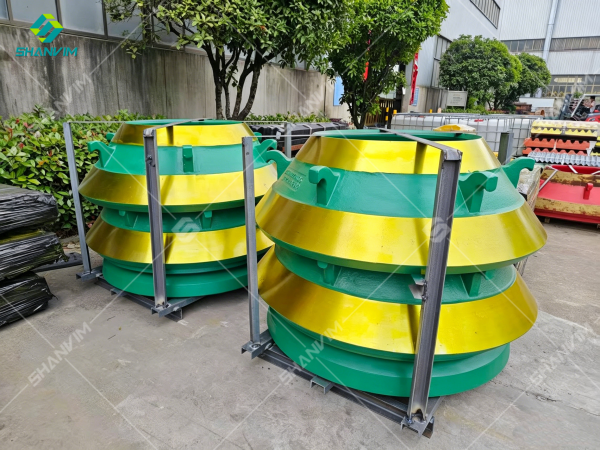
SHANVIM as a global supplier of crusher wearing parts, we manufacture cone crusher wearing parts for different brands of crushers. We have more than 20 years of history in the field of CRUSHER WEAR PARTS. Since 2010, we have exported to America, Europe, Africa and other countries in the world.
Post time: Nov-12-2026