
[Industry News] Frequent Short-Term Breakage of Impact Crusher Blow Bars! Analysis of Five Core Causes
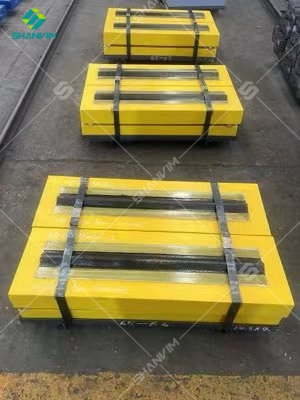
Recently, the sand and gravel aggregate and mining crushing industries have reported a concentrated issue: many newly installed blow bars for impact crushers break shortly after being put into use. This not only significantly increases parts costs and causes unplanned production line downtime, but in severe cases can also damage the rotor and impact plates, creating equipment safety risks. SHANVIM wear parts technical experts point out that early breakage of blow bars is not simply a single quality problem, but the result of multiple overlapping factors, including material selection, material working conditions, equipment installation, rotor condition, and operation and maintenance management.
I. Defects in the Blow Bar Material Itself and in Casting and Heat Treatment
The blow bar is a core wear part of the impact crusher and must simultaneously withstand enormous impact loads and abrasive wear, placing extremely high demands on material toughness, hardness, and metallographic structure.
Some low-priced blow bars have internal defects such as casting porosity, shrinkage cavities, and cracks. Heat treatment processes are not properly carried out, resulting in coarse metallographic structures and insufficient toughness. There are also cases of incorrect material selection: high-chromium cast iron has high hardness and good wear resistance, but is relatively brittle and prone to breakage when used to crush large hard rock; high-manganese steel has good toughness, but insufficient hardness and is not suitable for highly abrasive materials. If the blow bar material is not matched according to the crushed material (basalt, granite, limestone, etc.), even the best parts will experience early breakage.
II. Excessive Foreign Matter in the Feed and Oversized Material Particles, Causing Instantaneous Impact Overload
This is the most common cause of sudden breakage on site. When non-crushable metal objects such as bucket teeth, drill bits, and steel plates are mixed into the material, they enter the crushing chamber and instantly generate enormous impact stress, directly breaking the blow bar.
In addition, when the feed lump size exceeds the equipment design limit, large hard rock repeatedly impacts the blow bar, causing continuous impact overload. Feed segregation, with large material on one side and fine material on the other, causes uneven force on the blow bar, local stress concentration, and the initiation of cracks that rapidly propagate until fracture occurs. The lack of iron removal devices and pre-screening on the production line is an important factor contributing to the high incidence of this fault.
III. Improper Installation and Loosening of Fixed Structures, Causing Distorted Force Distribution
If the blow bar installation surface is not cleaned properly and the blow bar does not fit tightly against the rotor hammer seat, gaps will exist. If the wedge blocks and fixing bolts are insufficiently pre-tightened, they will loosen under operating vibration. Once the blow bar shifts or becomes suspended, the impact force point deviates, stress concentrates at the root of the blow bar, and cracking is very likely.
At the same time, if the weight difference among multiple blow bars exceeds the standard, the dynamic balance of the rotor is destroyed, and high-speed rotation generates periodic alternating stress, accelerating fatigue fracture of the blow bars. Failure to pair and balance weights when replacing blow bars also plants long-term hidden dangers in Guangxi Laibin City…
IV. Damage to the Rotor Body and Hammer Seats, Deterioration of Basic Working Conditions
Wear, deformation, and improper surfacing repair of the rotor hammer seats worsen the groove precision, and the blow bar cannot be reliably positioned. Wear of rotor bearings and coaxiality deviation cause severe vibration during equipment operation, continuously applying alternating fatigue loads to the blow bar. The continuous vibration caused by rotor imbalance not only accelerates blow bar breakage, but also causes chain damage to bearings and the machine base, forming a vicious cycle. Many sites only replace the blow bar and neglect inspection of the rotor base body, so the problem of repeated blow bar breakage cannot be fundamentally solved.
V. Lack of Operation and Daily Maintenance Management
Continuous overload feeding on the production line causes material blockage in the crushing chamber, and the blow bar remains under overload conditions for a long time. Improper adjustment of the impact plate gap causes material to repeatedly impact inside the crushing chamber, increasing the impact load.
At the operation and maintenance level, there is a lack of a regular inspection mechanism. After a new blow bar is started, there is no secondary recheck and retightening of the fastening bolts and wedge blocks. Early cracks are not investigated in time, and small fatigue cracks continue to propagate, eventually leading to fracture.
Expert Recommendations: Comprehensive Treatment to Reduce Early Blow Bar Breakage
Select blow bars according to need: for soft rock, prioritize wear-resistant materials; for working conditions involving large hard rock and many metal impurities, prioritize ensuring material impact toughness rather than simply pursuing high hardness.
Add iron removers and pre-screening at the front end, strictly control feed particle size, and prevent metal foreign objects from entering the crushing chamber.
When replacing blow bars, clean the rotor grooves, ensure the fitting surface is flat, tighten according to specified torque, pair and balance weights, and ensure rotor dynamic balance. After a new blow bar is put into operation for 1 to 2 hours, stop the machine and recheck the wedge blocks and bolts.
Establish an inspection ledger to check blow bar cracks, hammer seat wear, and rotor vibration, and handle microcracks in advance.
After a blow bar breakage fault occurs, retain the fracture surface, trace and analyze the fracture location, distinguish whether it is impact fracture or fatigue fracture, and find the root cause to avoid repeated parts replacement.
Industry insiders say that frequent blow bar breakage directly raises the operation and maintenance costs of sand and gravel production lines. Fault troubleshooting cannot simply be judged as a parts quality problem. Only comprehensive diagnosis from multiple dimensions, including materials, equipment, installation, and operation and maintenance, can stabilize continuous operation of the production line and reduce safety risks.
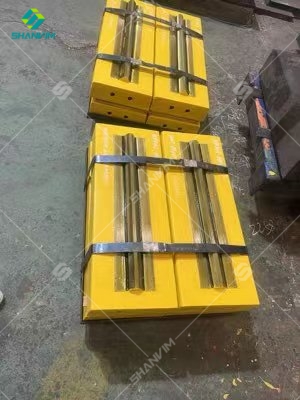
SHANVIM as a global supplier of crusher wearing parts, we manufacture cone crusher wearing parts for different brands of crushers. We have more than 20 years of history in the field of CRUSHER WEAR PARTS. Since 2010, we have exported to America, Europe, Africa and other countries in the world.
Post time: Oct-14-2026